It started as nothing more than a comment at a dinner party
Deborah Bull
A longer version of this diary was originally published in The Sunday Times, 11 July 1999.
It started as nothing more than a comment at a dinner party. Asked what I would like to do next, having worked my way through most of The Royal Ballet repertoire, I said that before I hang up my toe shoes and mothball the tutu, I would really like to work with Siobhan Davies. Siobhan Davies - Sue to her friends - is arguably the UK's foremost contemporary choreographer. Although she has very little experience of the ballet world, I have long suspected that she is one of the few choreographers who could navigate the gulf between classical and contemporary technique and, what's more, make the trip worthwhile. A curly haired, bespectacled man across the table put down his knife and fork and turned his attention to me. It was Michael Morris, Co-Director of Artangel. "We'll do that", he said.
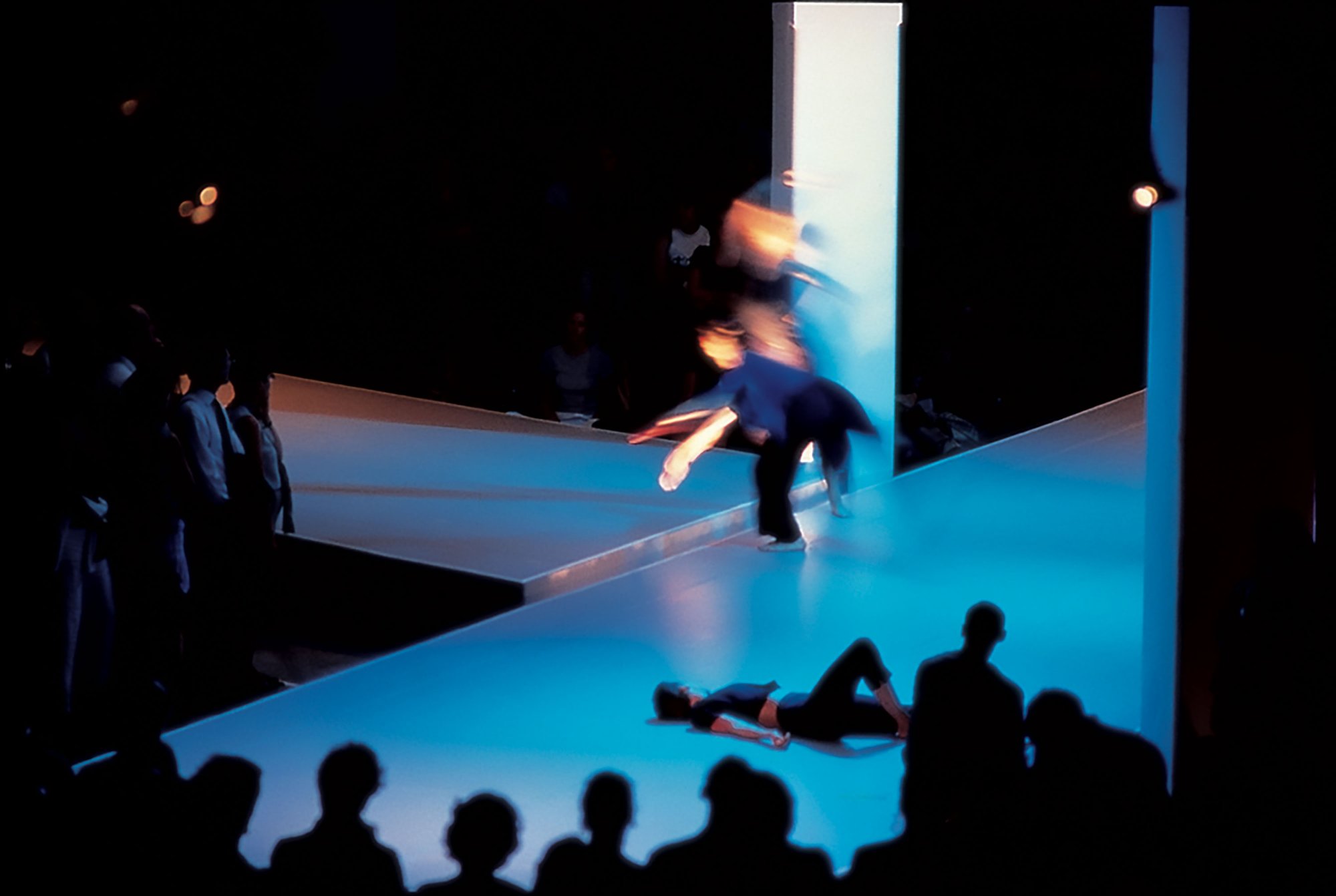
Image: The audience surround two dancers as they perform in a blur of motion under the blue lights of the Atlantis Building during 13 Different Keys, 1999. Photograph: Sarah Ainslie
Without a barre or a mirror in sight
Michael Morris
13 Different Keys lowers the drawbridge between the very distinct cultures of classical and contemporary dance, making unlikely bedfellows of Artangel and The Royal Ballet. Such a proposition could never have been realised without the openness and the generosity of Siobhan Davies and Deborah Bull, who two years ago began a conversation with us propelled by Gill Clarke and enthusiastically joined by The Royal Ballet - which continued at The Atlantis.
Any fears we may have had about the barriers of language and training were swiftly confounded in the studio, where a level playing field and a true sense of company were created from the start. For the Royal Ballet dancers, this was an inititation into working barefoot without a barre or a mirror in sight.
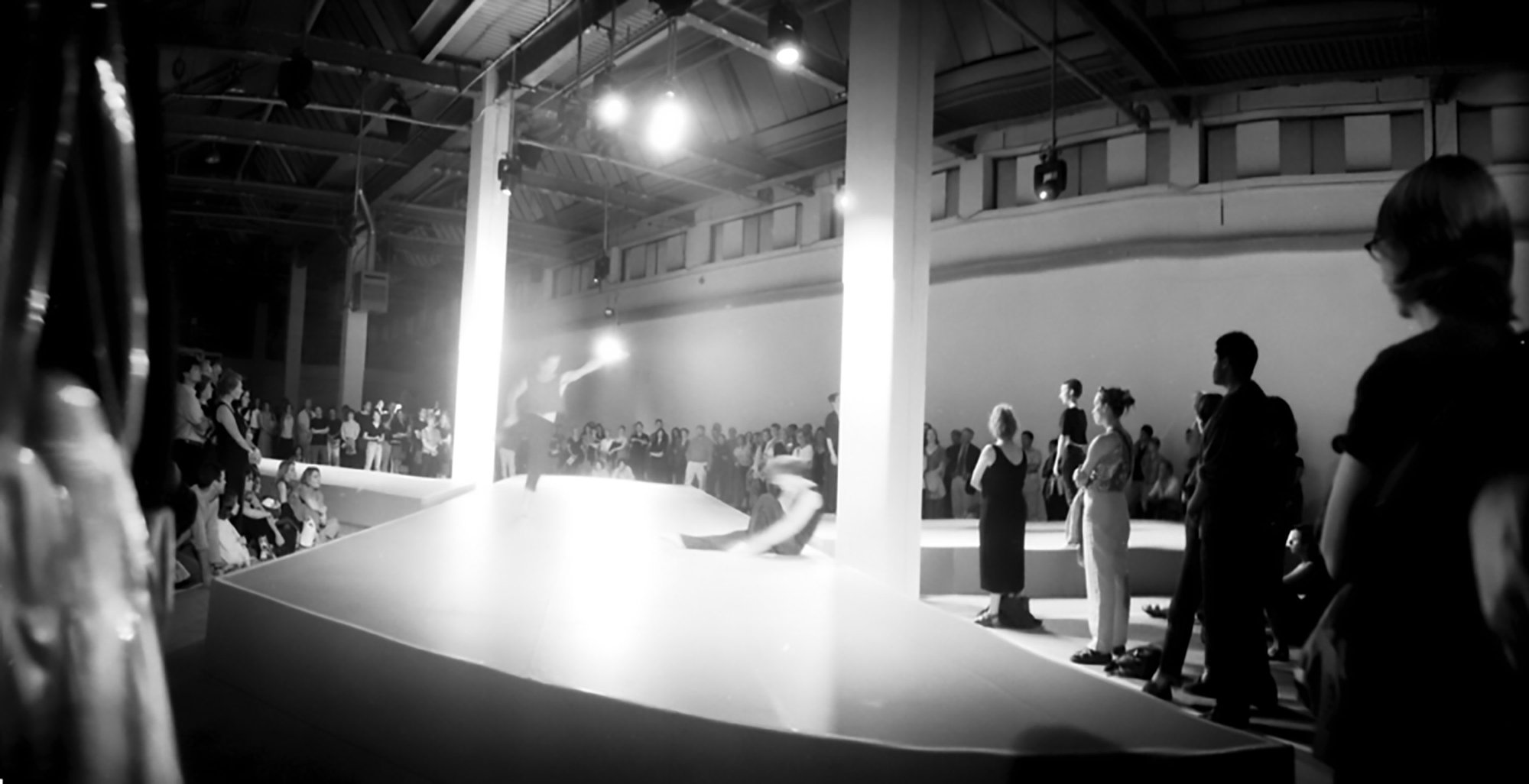
Image: The audience surround the dancers as they perform under the streaming lights of the Atlantis Building during 13 Different Keys, 1999. Photograph: Sarah Ainslie
It all made complete Artangel sense
Siobhan Davies
We had to leave our shoes above ground and put on steel capped boots and bright yellow hard hats. Then we descended into the Southwark underground station along a fire passage by the side of the escalator to reach a large hallway, a possible venue for the performances of 13 Different Keys.
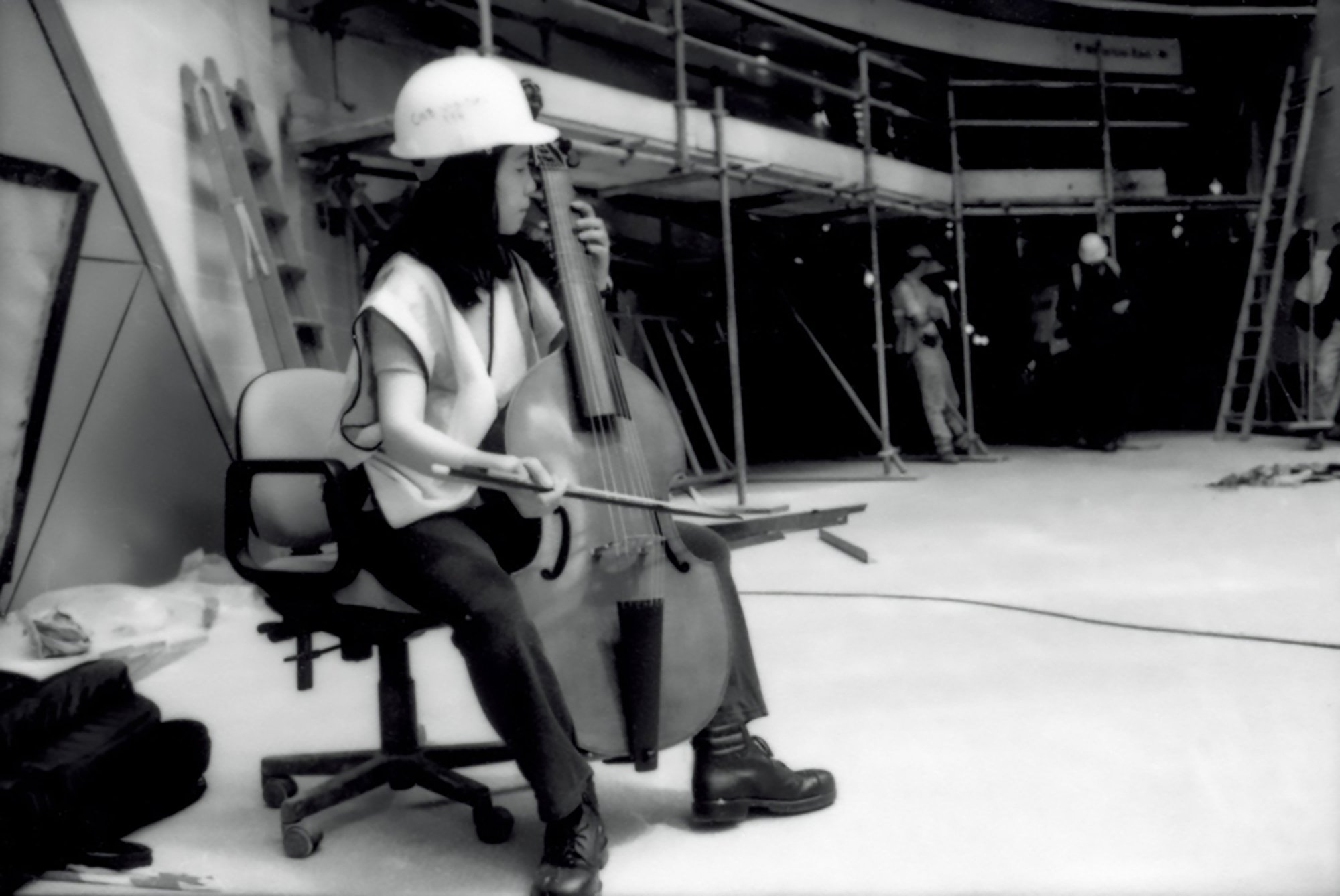
Producer, dancers, musicians and production technicians stood in this beautiful but unfinished space and we tried to imagine how to focus attention on a performing space with an audience that could move around. Dust filled the air, builders were criss-crossing the floor and shouting instructions. Reiko Ichesa brought out her Viola da Gamba, someone miraculously found her a chair and she started to play in order to test the acoustics. Everything changed. Our imaginations shifted. Whatever linear thinking that had been necessary to make decisions, involving the Artangel project or building a station, was suspended. Our timing changed. Everybody slowed down, stopped or moved quietly, their eyes and ears on Reiko and her music. An artist at work, a space transformed from its original use and a group of people that became a curious and surprised audience. It all made complete Artangel sense.
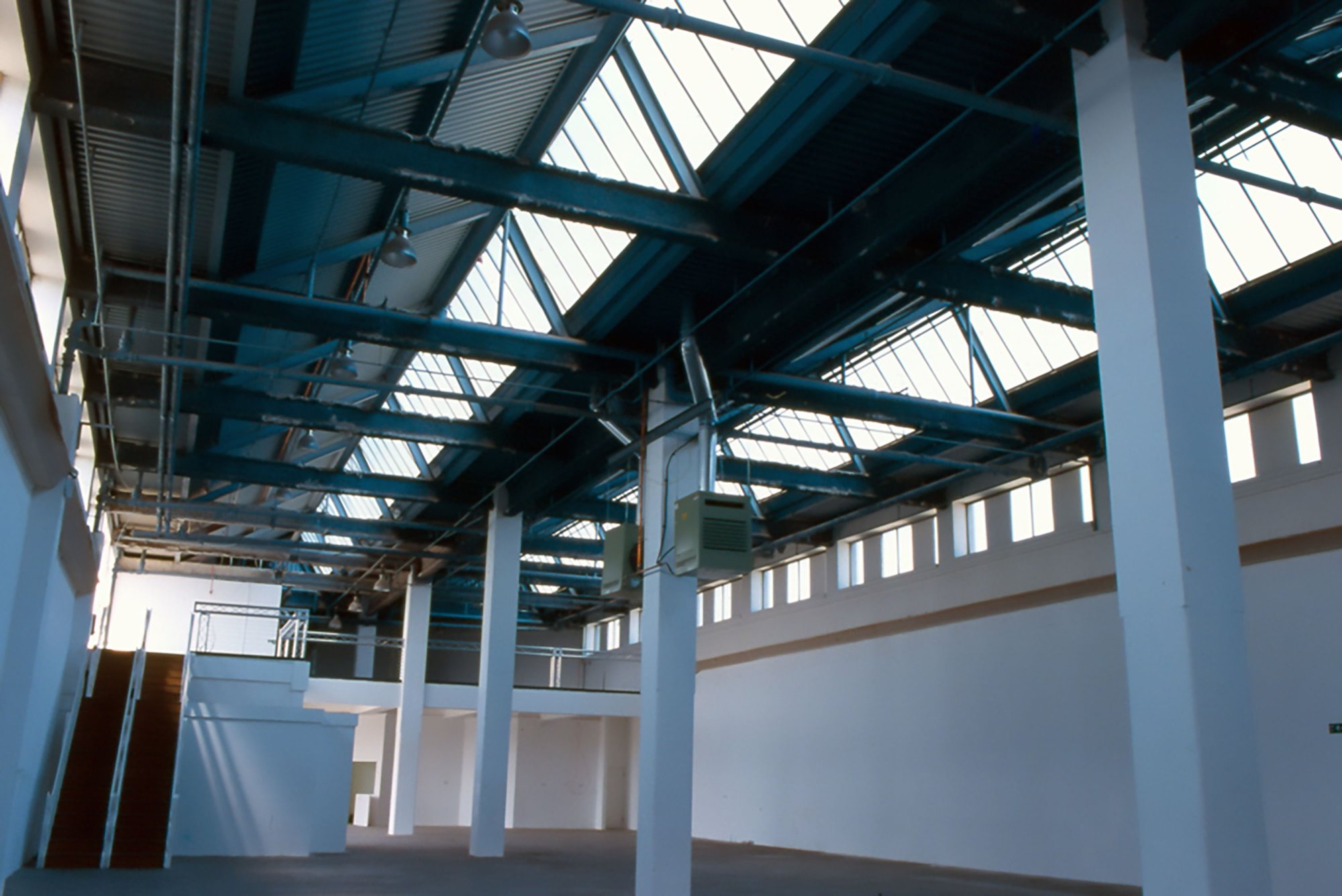
Image: The Atlantis Building before production on 13 Different Keys began in 1999. Photographer: Sarah Ainslie
We already know what a superb dancer Clarke is, but a revelation is what Davies's free-flowing choreography does for the trio from the Royal. Each takes on a whole new personality in Davies's hands. Liberated from the constriction of classical ballet, Bull and her colleagues relax into new vistas of heightened self expression. — Debra Craine, The Times, 19 July 1999
Selected Press
To Davies's boundless credit, the assumed clash between classical and contemporary styles of movement proves a chimera. What emerges in her hands is a richly detailed hybrid that takes the best from both... To the plangent strains of Marin Marais, played live on viola and harpsichord, five dancers whose training is worlds apart harmonised happily. You can spot the odd pure ballet step... but essentially, this is vintage Davies: ever inventive, beautifully paced movement that seems to melt the hard surface of the floor. — Jennie Gilbert, The Independent, 18 July 1999
The collaborators of 13 Different Keys needed a space that was large enough for dance but unlike a conventional theatre. They also wanted the audience to be moving around, within touching range of the performers. As Bull says, "People are used to seeing ballet dancers from a distance, and Sue (Siobhan Davies) was interested in getting us off that pedestal." Davies elaborates: "One of the most exciting things for me about watching dancers in the studio is seeing all that gorgeous human information stored in their bodies." — Judith Mackrel, The Guardian, 13 July 1999
If one began to move around the gallery, however, as I and a few others did, the piece came into a totally different focus, and vistas opened up that were all the more pleasing for being accidental. Manoeuvring my way to the bottom of the cross, it suddenly looked like a long avenue down which four dancers were leaping at a furious pace towards me. Emerging out of a dense group I saw Clarke and Bull being blown in a tumbling duet across my line of vision. As I moved around I invented my own structure for the piece. — Judith Mackrell, The Guardian, 17 July 1999
Siobhan Davies
Siobhan Davies first worked with Artangel on 13 Different Keys in 1999. In 2014 a live work Davies choreographed with dance artist Helka Kaski was performed as part of the events programme for Artangel project, Plot.
Siobhan Davies, orginally trained in art, has been at the forefront of new developments in dance for the past two decades, dancing with the London Contemporary Dance Theatre in the 70s before becoming its lead choreographer and then founding her own award-winning company since 1988. She has received numerous awards, including a Fulbright Arts Fellowship, four Digital Dance Awards, and six nominations for the Prudential Award for Dance, which she won in 1996. In 1993 and 1996 she won the Olivier Award for Winnsboro Cotton Mill Blues and The Art of Touch respectively. The Art of Touch also won the 1996 Evening Standard Award for Outstanding Production. Davies was appointed both Choreographer in Residence and Senior Research Fellow at the Roehampton Institute, London and in October 1996, she accepted an Honorary Fellowship at Trinity College of Music.
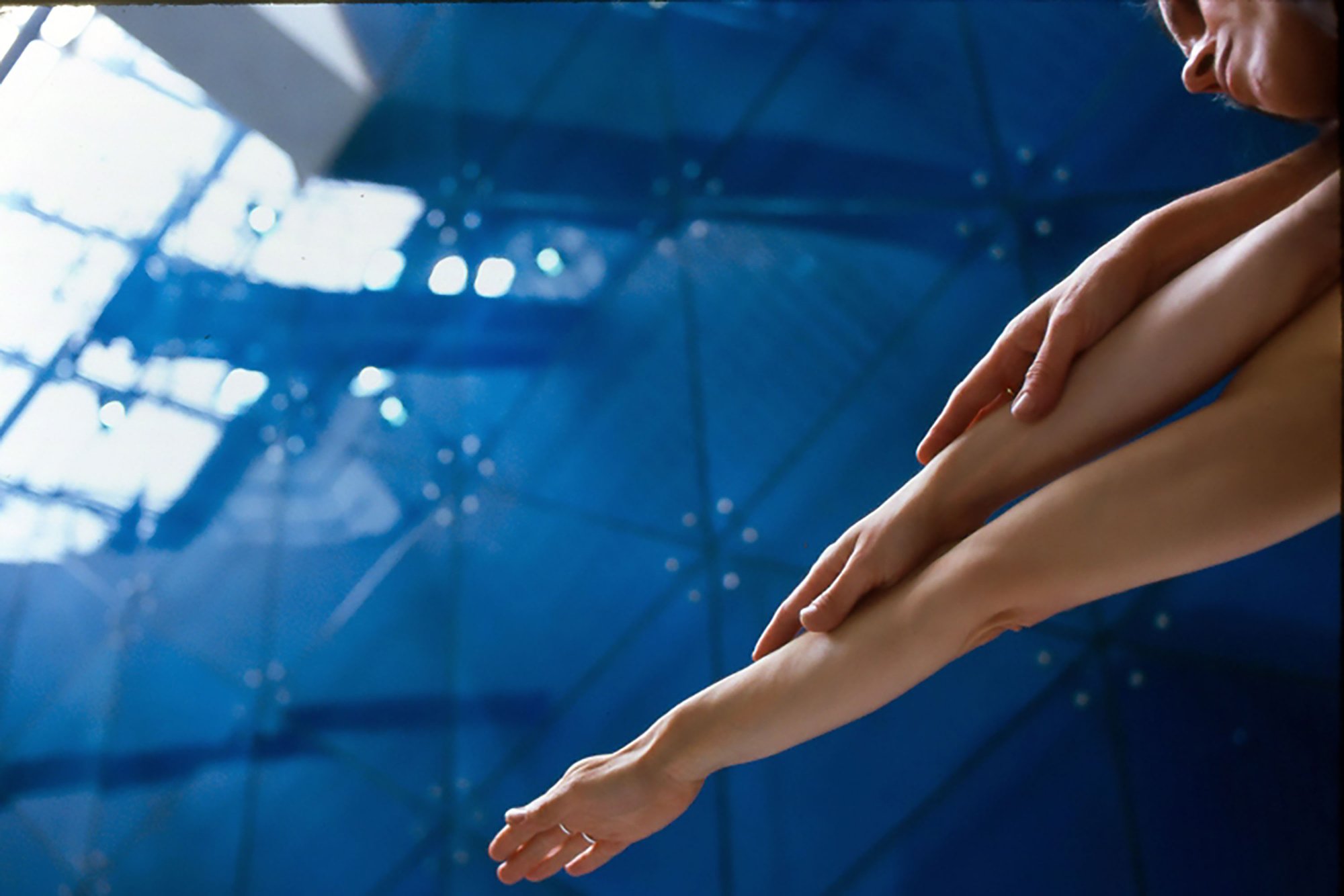
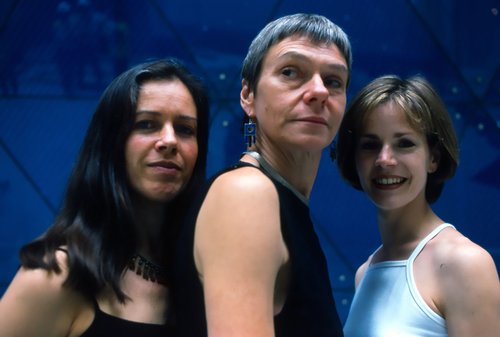
Images: Siobhan Davies face peeks into the top right corner of the image, as Gill Clarke and Deborah Bull rest their outstretched right arms on top of hers, reaching towards the ceiling of the Atlantis Building during 13 Different Keys, 1999 (left) and portrait of Gill Clarke, Siobhan Davies and Deborah Bull (above). Photographs: Sarah Ainslie
Gill Clarke
Gill Clarke studied English and Education at York University, she is a highly regarded independent dance artist and a regular Davies collaborator as well as a founding member. She was recipient of a London Dance and Performance Award and has worked with other choreographers and companies including Janet Smith, Rosemary Butcher and Rosemary Lee. A performer, teacher and choregrapher of international standing, she is also a vigirous campaigner for contemporary dance.
Gill Clarke, one of the foremost contemporary dancers of her generation, sadly passed away in November 2011.
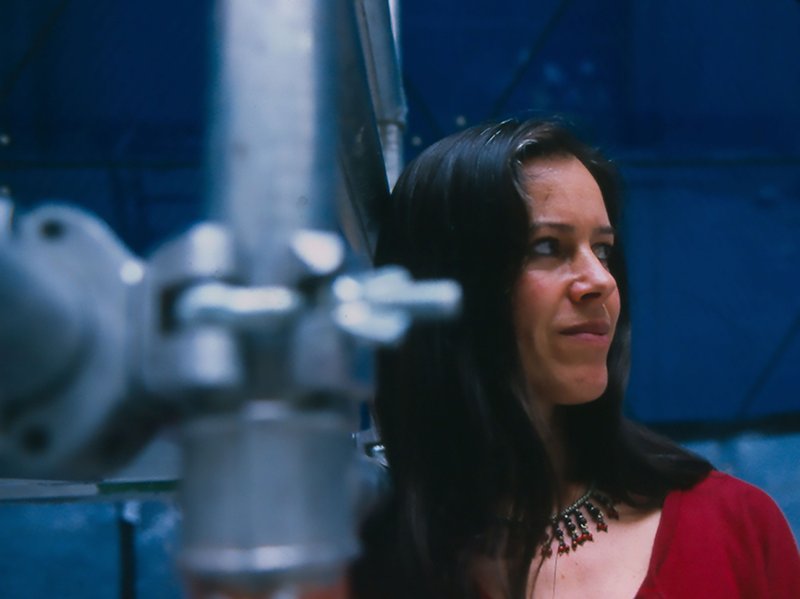
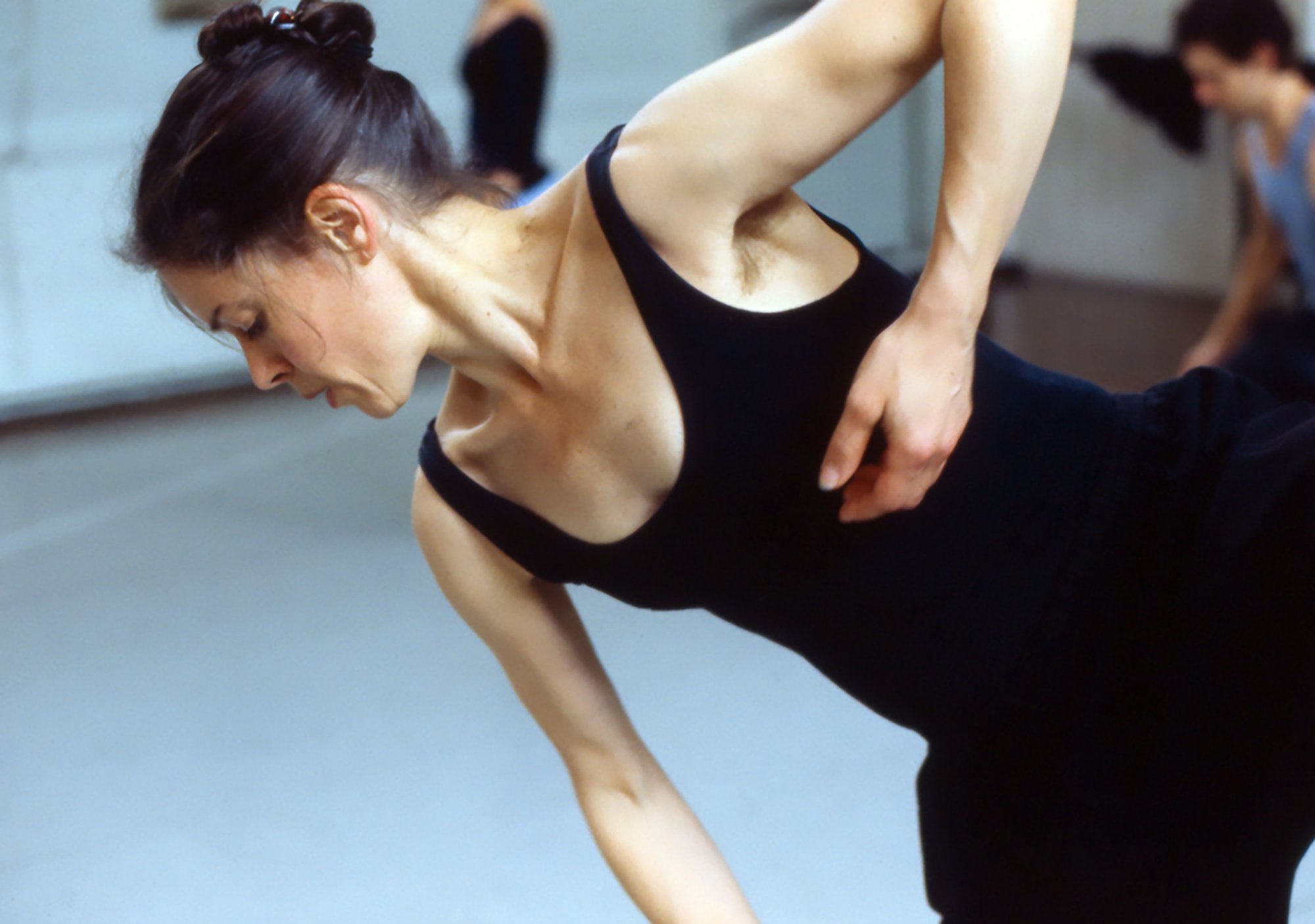
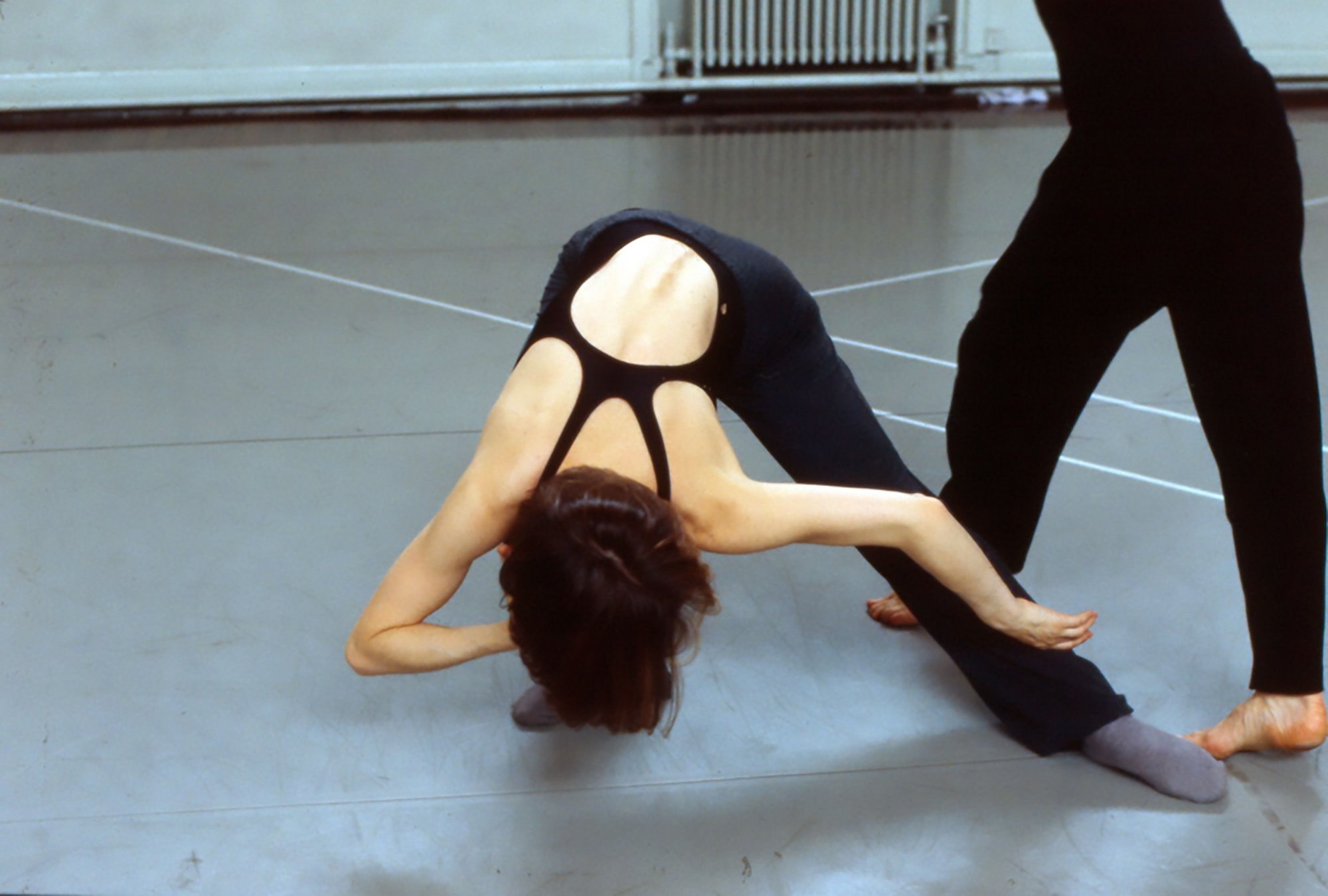
Images: Gill Clarke rehearsing for 13 Different Keys, 1999 (left) and portrait of Gill Clarke (above). Photographs: Sarah Ainslie
Deborah Bull
Deborah Bull has been a principal artist at the Royal Ballet since 1992 and one of its most articulate advocates for change and renewal. She has created roles for Ashley Page and Twyla Tharp and has received particular praise for her performance of the works of George Balanchine and William Forsythe. She has served on the board of the Arts Council England and The South Bank Centre, and as a Governor of the BBC. Deborah became Creative Director of ROH2 in 2002 and now serves as Creative Director of the Royal Opera House.
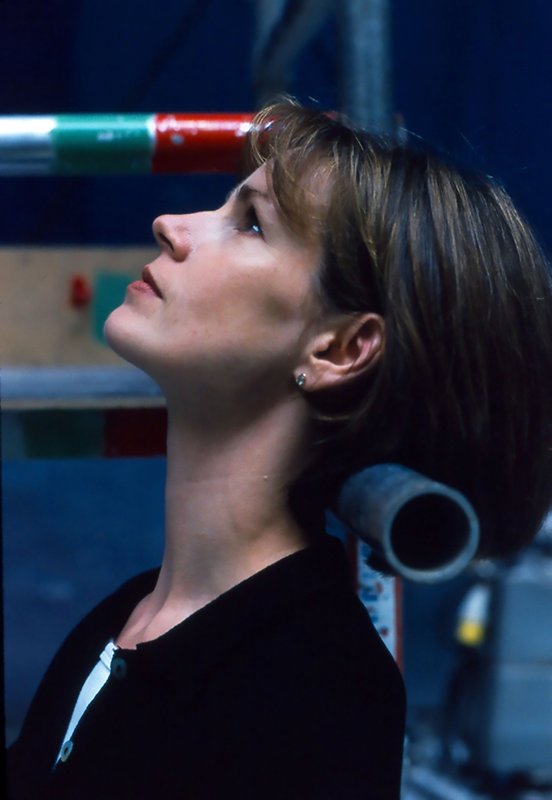
Images: Deborah Bull and Gill Clarke rehearsing for 13 Different Keys, 1999 (left) and portrait of Deborah Bull (above). Photographs: Sarah Ainslie
Production Credits
Credits
Choreography — Siobhan Davies
Performers — Peter Abegglen, Deborah Bull, Gill Clarke, Matthew Morris and Jenny Tattersall
Music — Marin Marais - Le Labyrinthe, La Tartarine, Sarabande, Tombeau pour M. de St. Colombe, Le Tourbillon, François Couperin - Les Barricades Mystérieuses
Played by — Reiko Ichise (viola da gamba) and Carole Cerasi (harpsichord)
Production Design — David Scholefield
Lighting Design — Peter Mumford
Production Management — Artcell
Production Co-ordination — Tabitha Clayson
Varilite Operator — Adrian Plaut
Technical Director — Geoff Wheel
Stage Management — Julia Simon
Costumes — Sasha Keir
Production Assistant — Michael Kruger
Lighting Equipment — Varilite Production Services Ltd
Sound — Richard Nowell Sound Services
Rigging — Erik Gibbons
Press and PR — Tony Shepherd
Photography — Sarah Ainslie
Graphic Design — Eureka\
Read credits and artist biographies in full
Image: Reiko Ichise wearing a hard-hat and high vis bib, plays the viola da gamba on an office chair on location during production of 13 Different Keys at the Atlantis Building, 1999. Photograph: Sarah Ainslie
Who made this possible?
Credits
Commissioned and produced by Artangel in association with the Royal Ballet, supported by Arts Council England, the London Dance Network and the Quercus Trust. Artangel is generously supported by the private patronage of The Artangel International Circle, Special Angels, Guardian Angels and The Company of Angels.