In The Artangel Collection
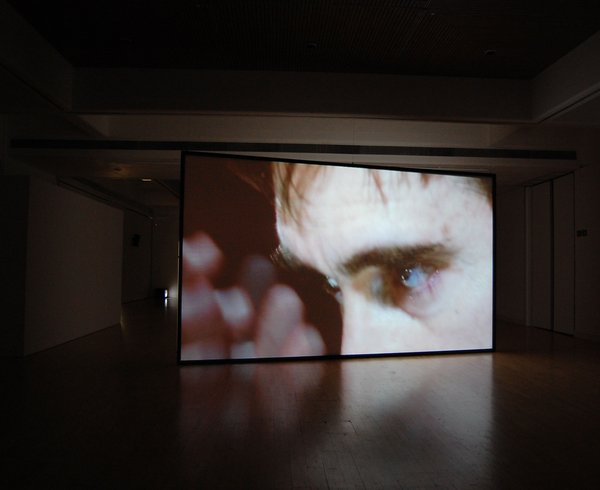
The installation version of this project is a large scale projection of Feature Film accompanied by a small monitor playing Alfred Hitchcock’s Vertigo. Gordon also made a single screen version of Feature Film for presentation in cinemas. Both versions have been widely presented and are available to loan.
Register your interest
Fill out the form to find out more about how you can borrow and present this work, including tech specs, use cases, and more.
Douglas Gordon on Feature Film
My first encounter with Artangel was with James Lingwood, in a cafe, over a beer, on a wet, windy day, under a cloud, in Glasgow. That was in 1993.
Six years later, in London, we realised a project that had evolved over further drinks, in many bars, in other cities and with other people.
When we began discussions, we talked around and about the many possible and even more improbable ideas that I had hidden away in the back of my head – imagining that they would never exist outside of my late-night, half asleep, mostly-forgotten, hallucinations.
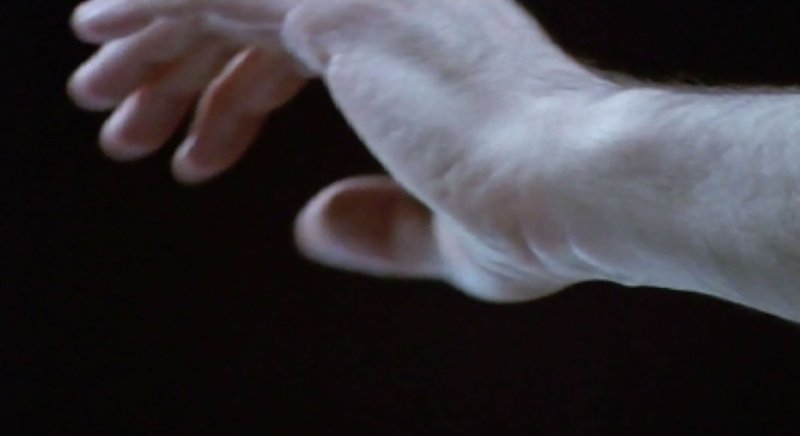
Still of conductor James Conlon's hand, taken from Feature Film, 1999. Still: Douglas Gordon
Making Feature Film
James Lingwood
May 2002
Feature Film had a long genesis: we first talked back in 1993 in Glasgow and the project wasn't realised until 1999.
There were several ideas which we didn't follow through. Once we looked at The Exorcist and The Song of Bernadette overlaid together on tape. Although the idea was interesting and the final realisation, at the 'Munster Sculpture Project', was very powerful, I guess we didn't do that together because when Douglas proposed the idea the work was already in many ways done. It didn't really need Artangel....
I remember spending a weekend with Douglas in Berlin. He had prepared various CDS of film music which we listened to intently, The Greatest Story Ever Told, Ben Hur, Psycho etc. Douglas was building me up to listen to Vertigo. We listened to the music for the mm in its entirety, and then watched the film. There was almost no need for Douglas to explain - which he did very convincingly why the work he needed to make needed to be based on Bernard Herrmann's score for Hitchcock's film, with its themes of doubling and duplicity.
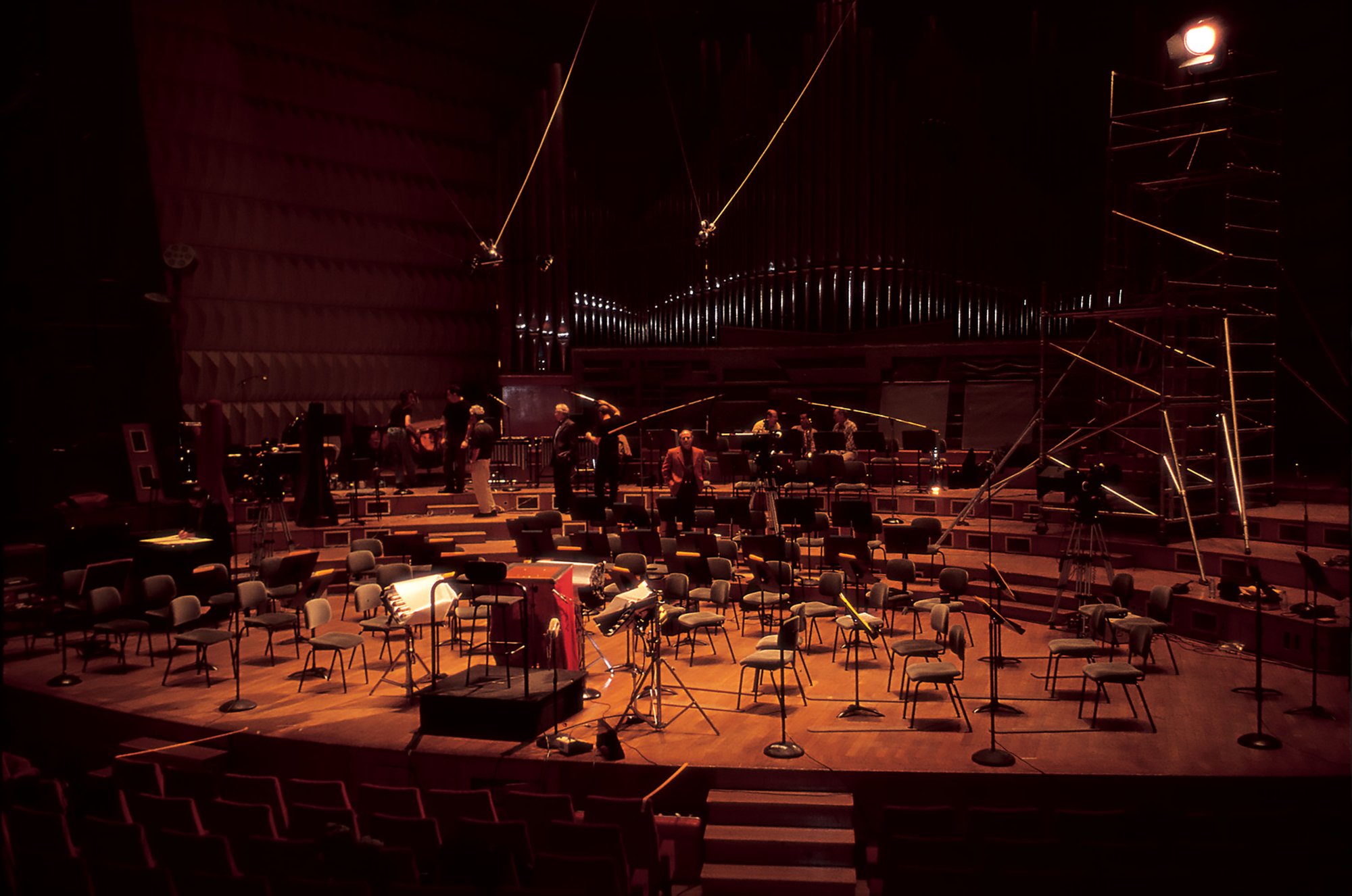
Image: Crew on stage in Paris, during production of Feature Film, 1999.
Douglas Gordon: Feature Film, the book
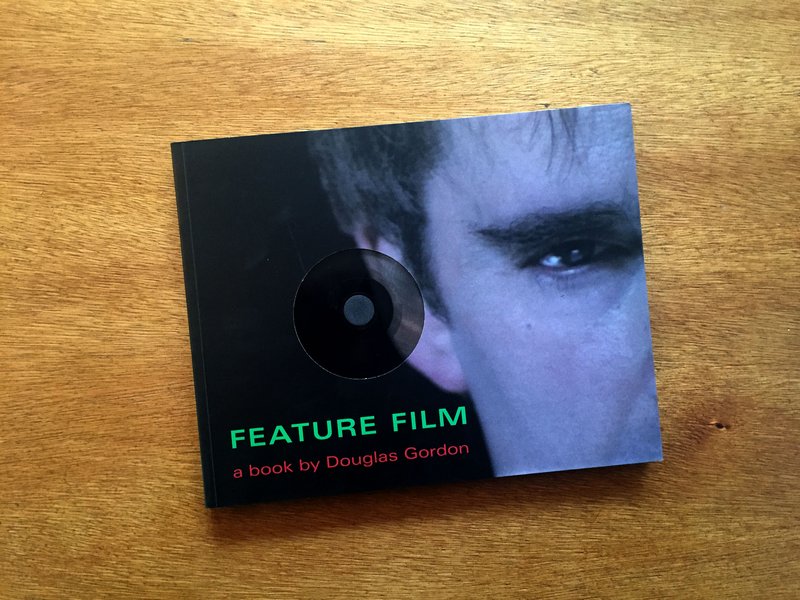
Feature Film continues Douglas Gordon’s fascination with the films of Alfred Hitchcock. Focusing this time on the music, Feature Filmdraws on the momentous score by Bernard Herrmann for Hitchcock’s classic Vertigo. Douglas Gordon, in his directorial debut, has created a new film featuring James Conlan (chef d’orchestre of the Paris Opera), in which the music is played out through his dramatic head and hand gestures.
The book is published as a parallel work with reproductions of movie stills from Feature Film and Vertigo that represent the same moment in the score along with a CD that contains a complete new recording of the music from Vertigo.
- Co-published by Artangel, Book Works and Agnès b, January 1999
- The book features texts by Raymond Bellour and Royal S. Brown
- 128pp
- Softback
- Colour photographs and CD-Audio
- 240 x 190 mm
- ISBN: 9781902201054
Douglas Gordon
Douglas Gordon was born in 1966 in Glasgow, Scotland. He lives and works in New York. After receiving a B.A. at the Glasgow School of Art from 1984 to 1988, Gordon undertook a graduate program at the Slade School of Art in London from 1988 to 1990. Through his work in video, photography, and sculpture, Gordon addresses and explores universal dualities: life and death, good and evil.
Since his first solo show in 1986, he has exhibited extensively, including the Stedelijk Van Abbemuseum, Eindhoven, The Netherlands; the Musée d’Art Moderne de la Ville de Paris, Centro Cultrual de Belém in Portugal, Tate Liverpool and the DIA Center for the Arts in New York. A 2001 retrospective organized by the Geffen Contemporary in Los Angeles traveled to the Vancouver Art Gallery, Canada; the Museo Rufino Tamayo, Mexico City; and the Hirshhorn Museum and Sculpture Garden, Washington, D.C., Fundació Joan Miró, Barcelona; the Museum of Modern Art, New York; the National Gallery, Edinburgh, Scotland; and the Museum of Modern and Contemporary Art, Trento, Italy.
Gordon was the 1996 recipient of Britain’s Turner Prize, in 1997 was awarded Premio 2000 at the Venice Biennial, and in 1998 he was presented with the Hugo Boss Prize at the Guggenheim Museum in SoHo. He was also included in the SkulpturProjekte in Münster in 1997.
Gordon has since worked in collaboration with Philippe Parreno to produce a film about world-renowned French football player Zinedine Zidane. This video watches Zidane’s movement throughout an entire game, and captures Zidane in a multidimensional space leading the spectator to experience the sensations and movements of an athlete.
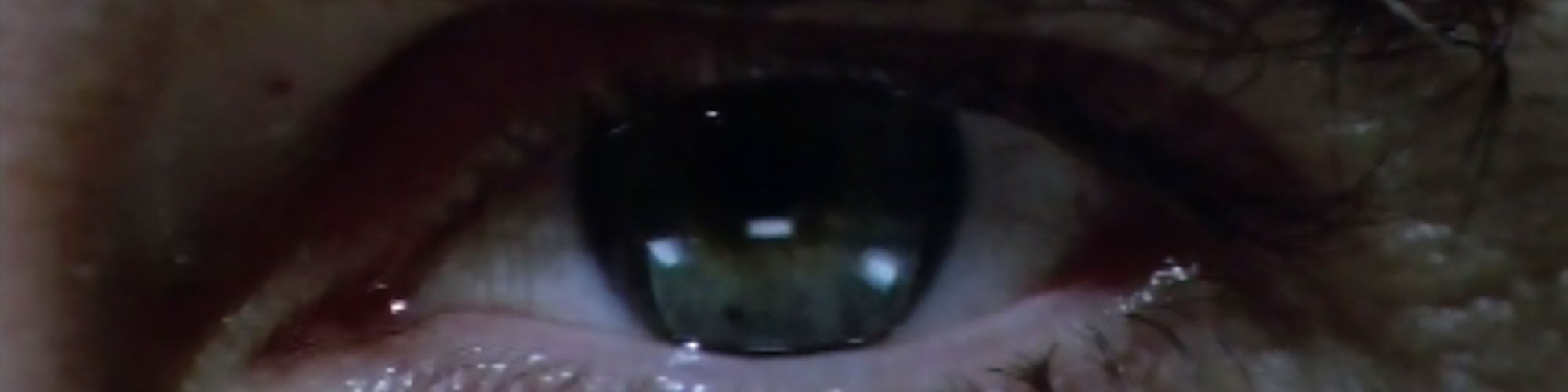
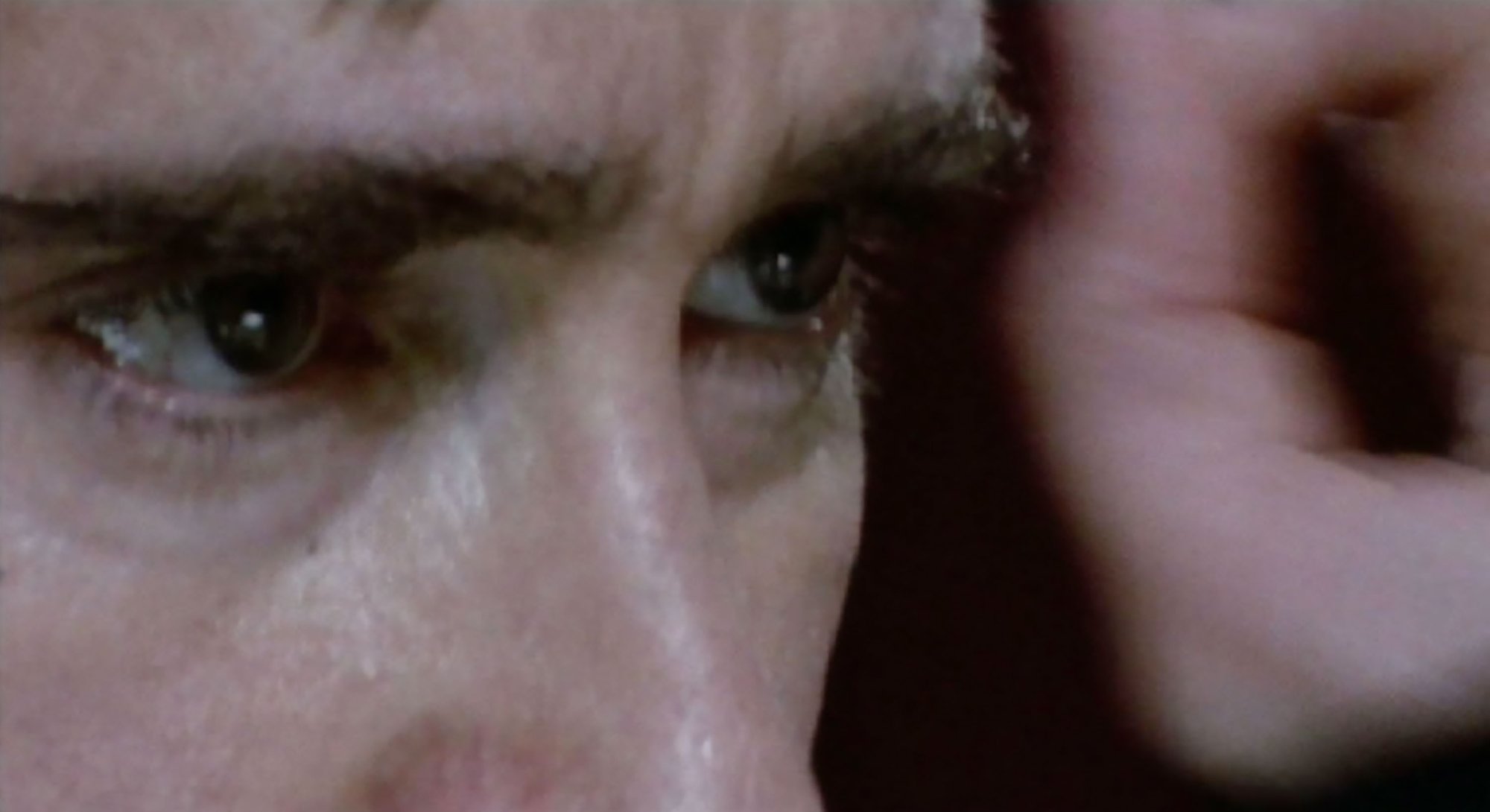
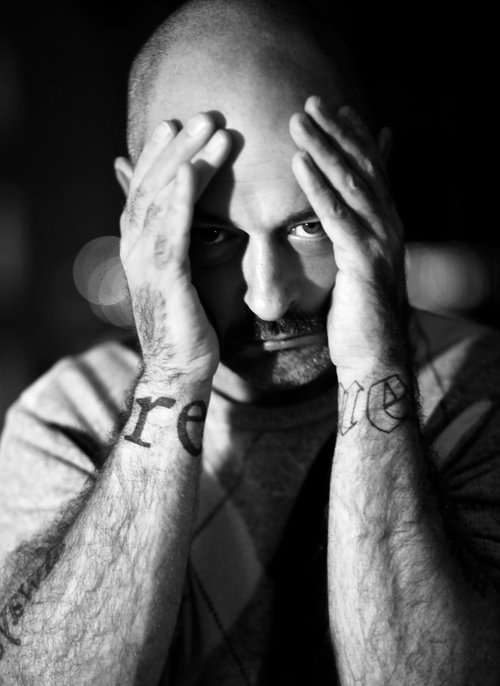
Still of conductor James Conlon's eyes, taken from Feature Film, 1999 (left) and portrait of the artist Douglas Gordon (above). Photograph: Marc Lilius
If Vertigo splits fictions apart, then Feature Film fractures expectations about how film functions. If Vertigo is about people going crazy, then Feature Film demands a kind of generous dis-equilibrium from its audience. — Frieze 97, September – October 1999
Feature Film is about the strangeness, beauty and glamour that the cinema used to have. It could almost be seen as a riposte to Hollywood’s recent frame-by-frame remake of Hitchcock’s Psycho, a project so redolent of cultural exhaustion that it might easily have been dreamed up by a postmodern artist such as Gordon himself. — Richard Dorment, The Daily Telegraph, 7 April 1999
By slicing off Herrmann’s work and holding it up for inspection, Gordon enables us to assess it with far greater clarity. And by showing how ardently Conlon responds to the score, the full extent of its capacity to ensnare us in Vertigo’s nightmarish convolutions is revealed. — Richard Cork, The Times, 7 April 1999
At several junctures the 1960s-style space-age harps and shrill violins become increasingly piercing when the frenetic hand movements suddenly disappear from screen – instead of signalling the end of a scary scene, the music continues to build, and you become more nervous waiting for the crash of the hands back into the realm of the camera. The music alone makes your stomach turn […] — Charlotte Mullins, Tate, Summer 1999
Credits
Co-produced by Artangel & Centre Georges Pompidou, Musée National d'Art Moderne, New Media Department as The Artangel / Beck's commission in association with Kölnischer Kunstverein/Central Krankenversicherung A.G. on the occasion of the CENTRAL ART AWARD 1998. It involved the participation of Agnès b. Caisse des Dépôts et Consignations and The Henry Moore Foundation with the support of Galerie Yvon Lambert, Paris and Lisson Gallery, London. Presented in London with the support of London Arts Board. Feature Film is included in The Artangel Collection, a national initiative to commission and present new film and video work, supported by the National Lottery through Arts Council England and the Esmée Fairbairn Foundation.
Artangel is generously supported by the private patronage of The Artangel International Circle, Special Angels, Guardian Angels and The Company of Angels.