In The Artangel Collection
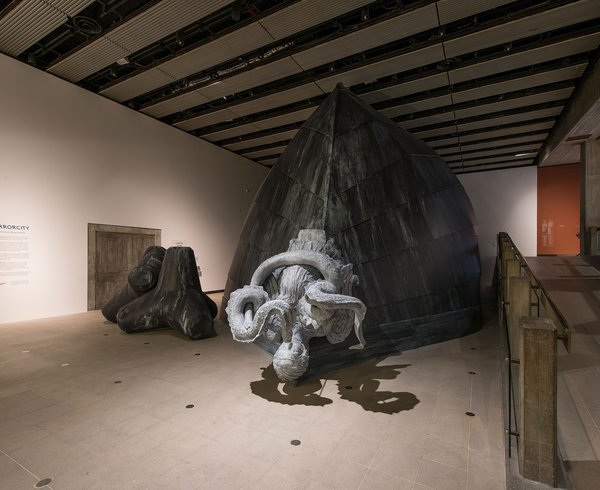
Nowhere Less Now is a two-channel film installation with accompanying sculptural works. Existing in editions 1- 8 (2012 - 2025), each version presented the work anew, with the films re-edited and the installation re-configured, in connection with the physical site and local histories. Resulting from the editions, there is a simplified version of the work that is available to loan that continues to weave together personal and fictional narratives to consider how history is created and truth perceived.
Register Your Interest
If you are interested in presenting this work, fill out the form to get access to technical specifications, use cases, and more to see if the work is suitable for your project.
Talk: Christine Oackley Harrington, Bohemian Occult Subculture
And other audio recordings
Talk: Christina Oakley Harrington, Bohemian Occult Subculture
Christina Oakley Harrington is the founder and managing director of the legendary Treadwell’s of London, a bookshop and events centre for the British pagan and esoteric community. She will discuss the Victorian ceremonial magic organisation the Order of the Golden Dawn, an organisation that forms part of the rich fabric of source material for Nowhere Less Now.
You can listen to the talk on Soundcloud.
You can listen to the project's other events on Soundcloud.
Talk: Nowhere Less Now — Simon O'Sullivan, A Diagram of the Finite-Infinite Relation
Lindsay Seers’ work has been deeply informed by French philosopher Henri Bergson (1859-1941), whose ideas around time and subjectivity are discussed here by Simon O’Sullivan. A Senior Lecturer in Visual Cultures at Goldsmiths College and Programme Leader for the MA in Contemporary Art Theory, O’Sullivan is an artist, writer and researcher. In recent years focusing on Guattari’s notion of the ‘production of subjectivity,’ he has drawn on the work of Spinoza, Bergson, the late Foucault and the writings of Deleuze and Guattari amongst others. This work has resulted in his new publication On the Production of Subjectivity: Five Diagrams of the Finite-Infinite Relation (Palgrave, 2012).
Talk: Nowhere Less Now — TJ Demos, Return to the Postcolony
In the context of Nowhere Less Now’s many references to historical colonialism, T.J. Demos discusses his upcoming book Return to the Postcolony: Spectres of Colonialism in Contemporary Art (Sternberg Press). He is an art critic, curator, reader in the Department of Art History, University College London and writes widely on modern and contemporary art.
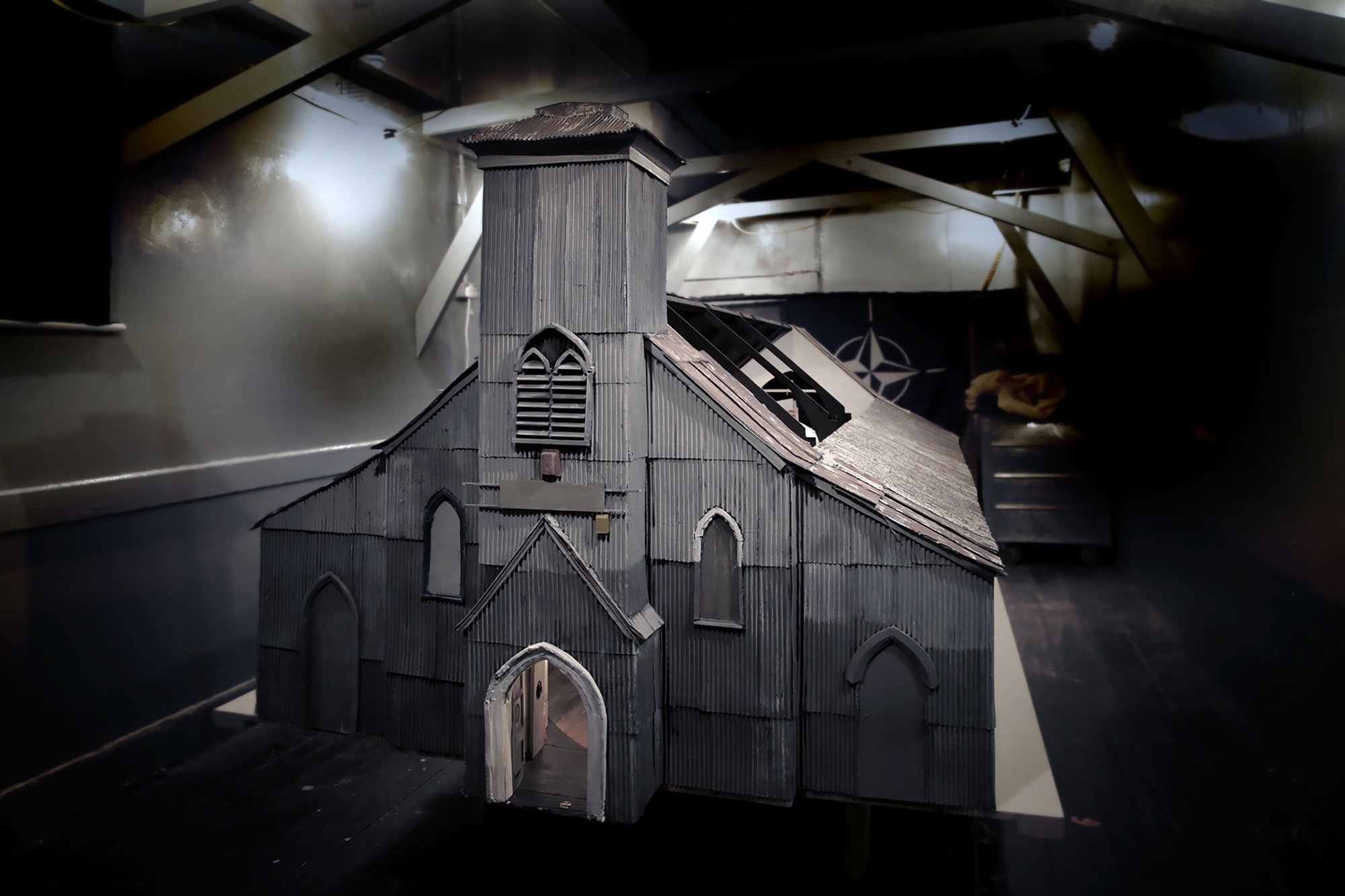
Image: Model of The Tin Tabernacle as installed for Nowhere Less Now, 2012. Photograph: Lindsay Seers
Democratic Visions
by John Mullarkey
5 October 2012
‘I start with a question – where does the past exist? But the starting point is from a notion of the philosopher Henri Bergson’s intuition as practice, to make art ontological’. — Lindsay Seers To make art ontological – to give it ‘being’. And why not also make ontology art, give it ‘perception’ (aesthetics)? After all, for Bergson, philosophy is art for the masses, offering altered perceptions ‘more continual and more accessible to the majority of men’ – a democracy of vision irrespective of artistic aptitude: ‘all things acquire depth – more than depth, something like a fourth dimension which permits anterior perceptions to remain bound up with present perceptions, and the immediate future itself to become partly outlined in the present’ [1]. Nowhere Less Now, with its equality of images – ‘everything is images, and all images are equal’ [2], no less than Bergson’s Matter and Memory which begins and ends ‘in the presence of images’ [3] – performs these anterior perceptions and this outlined future, and gives them being through eyes, cameras, costumes, avatars, ships, churches, cults, animal sacrifice….
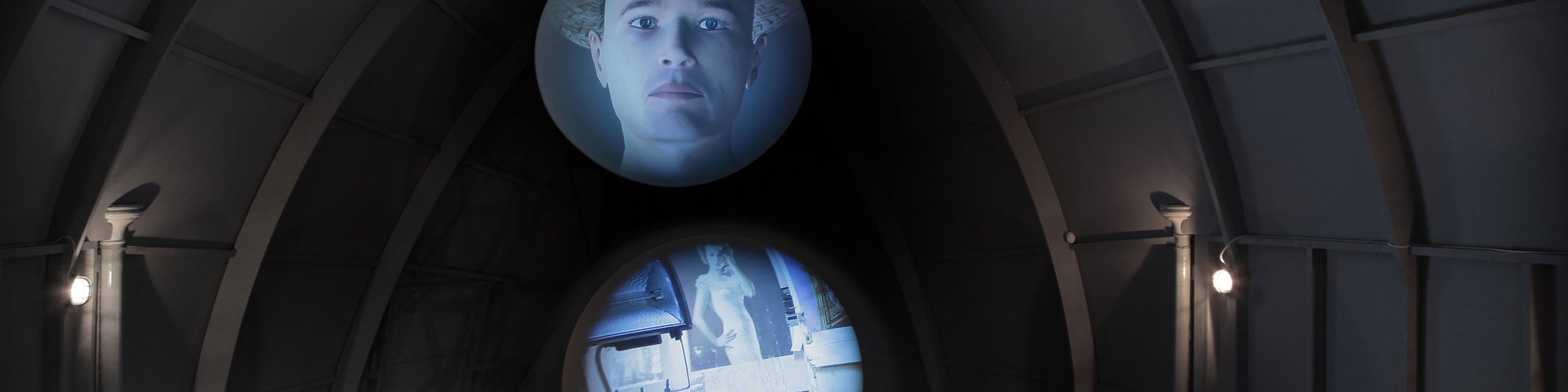
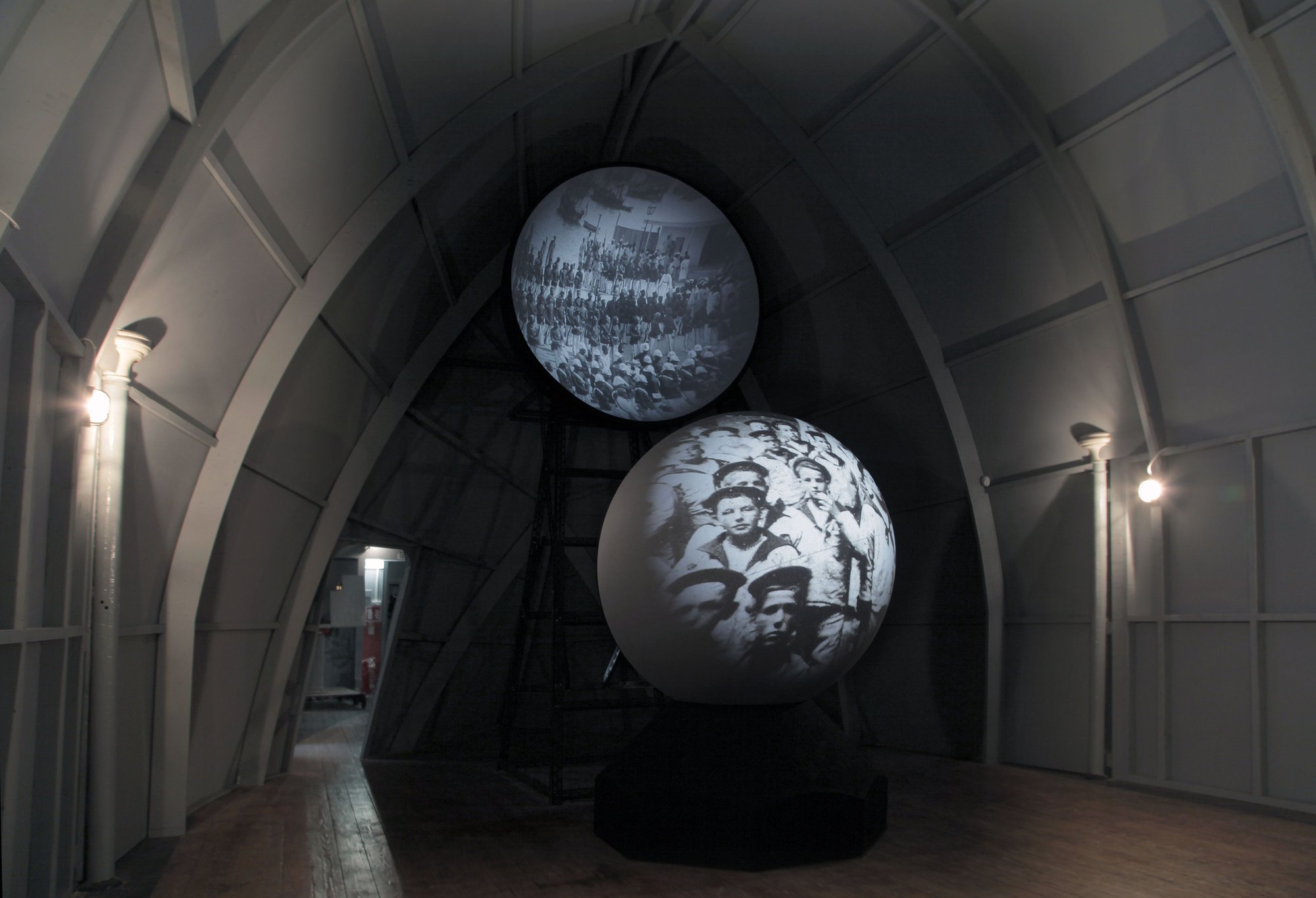
Image: Black and white images of sailors are projected onto two screens, concave and convex, as installed in The Tin Tabernacle, Kilburn, during Nowhere Less Now, 2012. Photograph: Lindsay Seers
Autodestroy
by Ned Beauman
In April the fifth annual BCP & IT Disaster and Data Recovery Conference was held in Mumbai. In May the fourth annual Information Destruction Exhibition & Conference was held in London. Were there any double agents who attended both? In my imagination, the information destroyers and the data recoverers are sworn enemies like UNCLE and THRUSH or SHIELD and HYDRA, always plotting to humiliate the other side. But they also have to stay in business, and in that respect it's clear who has the upper hand. In the future, there will be more and more data that needs to be destroyed, and less and less that needs to be recovered, because we are coming to the zenith of the autosave and the cloud.
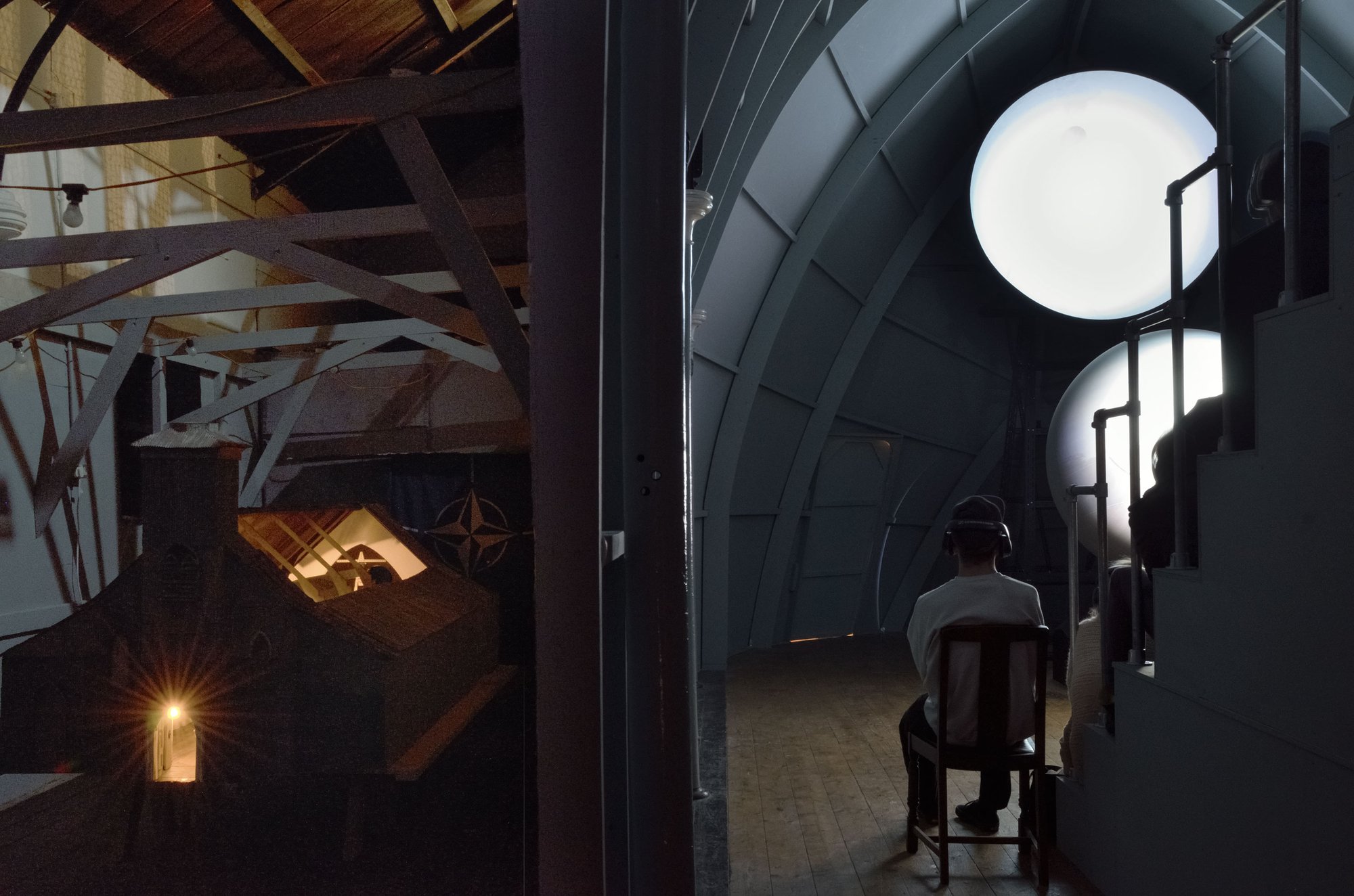
Image: Nowhere Less Now installation at The Tin Tabernacle Kilburn, 2012. Photograph: Ewa Herzog
Lindsay Seers
Lindsay Seers studied at the Slade School of Art and Goldsmiths College in London during the 1990s. She has emerged as one of the most distinctive new figures in British art. Her installation Extramission 6 (Black Maria) was one of the highlights of Altermodern, the Tate Triennial in 2009. The same year, Seers exhibited It has to be this way at Matt’s Gallery in London. In 2010/11 Seers presented a sequel, It has to be this way² , commissioned by SMK (National Gallery of Denmark) and Mead Gallery, Warwick and presented by Baltic Centre for Contemporary Art, Gateshead.
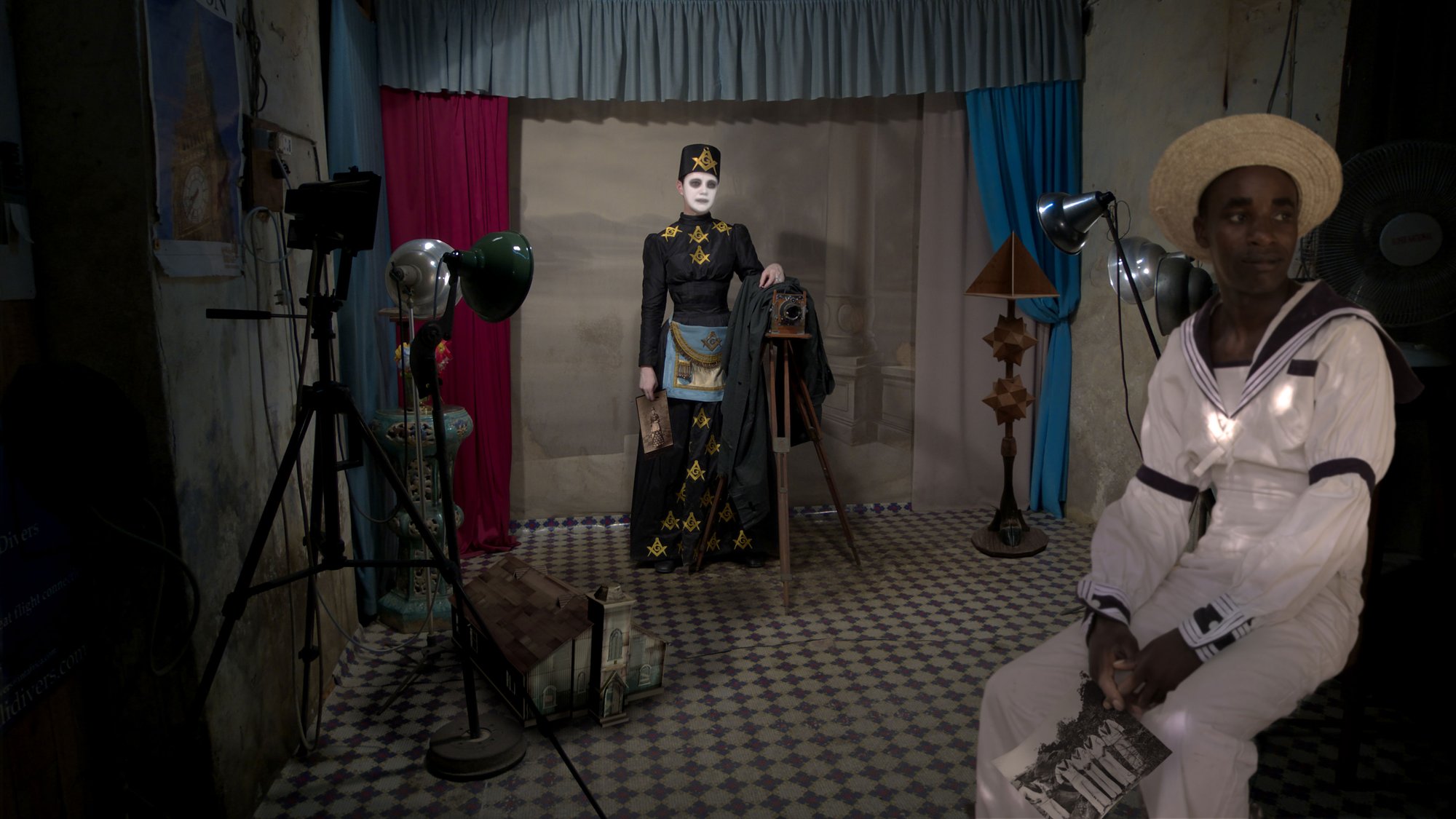
Image: Lindsay Seers in costume during production of Nowhere Less Now, 2012. Photograph: Lindsay Seers
Nowhere Less Now offers a powerfully elegiac paean to the still photograph. It pays heed to images as embodied in fragile yet obdurately physical things that bind subjects and places together back and forth across time and space. — Jo Applin, Artforum
In one close-up shot, Edwards gazes towards the future with two different coloured eyes. Perhaps the two screens Seers uses in this mesmeric show reflect her belief that Edwards’ unusual ocular condition has something to do with an unborn twin. His eyes were probably the starting point for many of the abstract images now appearing on the screens. Yet these forms are also redolent of planets suspended in the cosmos, and Seers plays with ideas of a world darting restlessly between past, present and future. — Richard Cork, Financial Times, 10 September, 2012
As the lights come up, you're still puzzling things out (a feeling that will last for days, and probably for ever). It takes a moment, then, to notice what the dark previously concealed: that Seers has made her own additions to the folk-art interior of the tabernacle, and that you're sitting in what appears to be the upturned hull of a ship. Knock its sides with a knuckle and you will hear the stark clank of metal. The disorientation doesn't end here. Afterwards, free to explore, I wandered into a tiny side chapel. It has a medieval altar and a lectern whose base is – wait for it – a cloven hoof. The effect was uncanny. — Rachel Cook, The Guardian, 2 September 2012
While the artist's deft touch dispenses with nostalgia, Nowhere Less Now offers a powerfully elegiac paean to the still photograph. It pays heed to images as embodied in fragile yet obdurately physical things that bind subjects and places together back and forth across time and space. — Jo Applin, Artforum, 2012
Credits
Commissioned and produced by Artangel Sharjah Art Foundation and MONA (Museum of Old and New Art), Hobart, Australia. The presentation in London was supported by The Henry Moore Foundation. Nowhere Less Now is included in The Artangel Collection, a national initiative to commission and present new film and video work, supported by the National Lottery through Arts Council England and the Esmée Fairbairn Foundation.
Artangel is generously supported by the private patronage of The Artangel International Circle, Special Angels, Guardian Angels and The Company of Angels.