

In The Artangel Collection
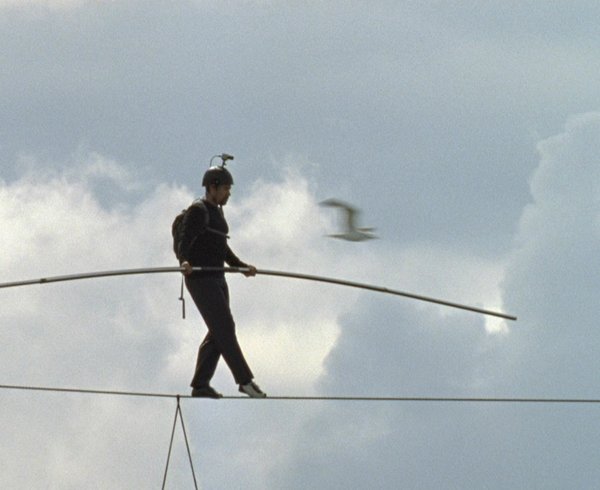
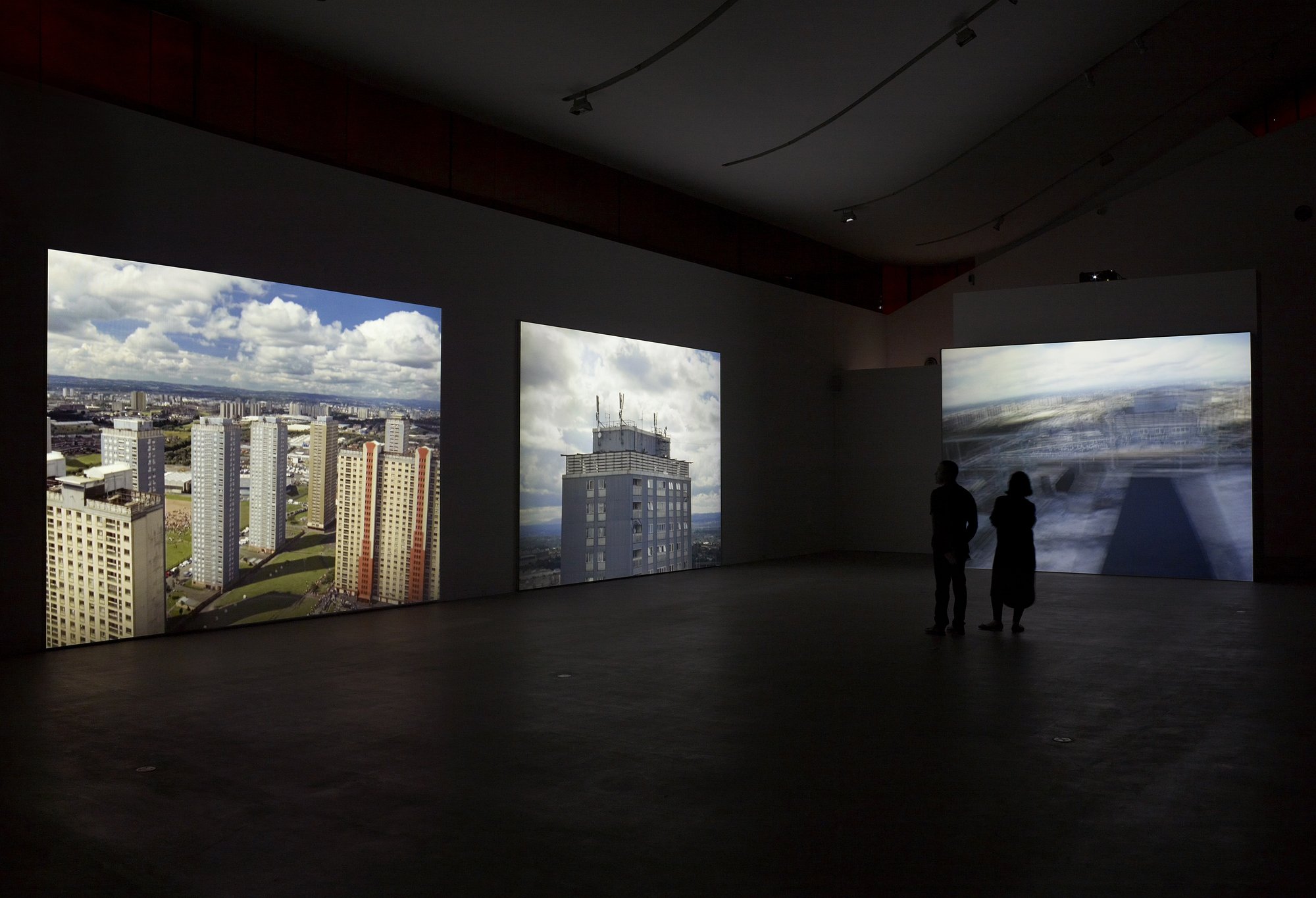
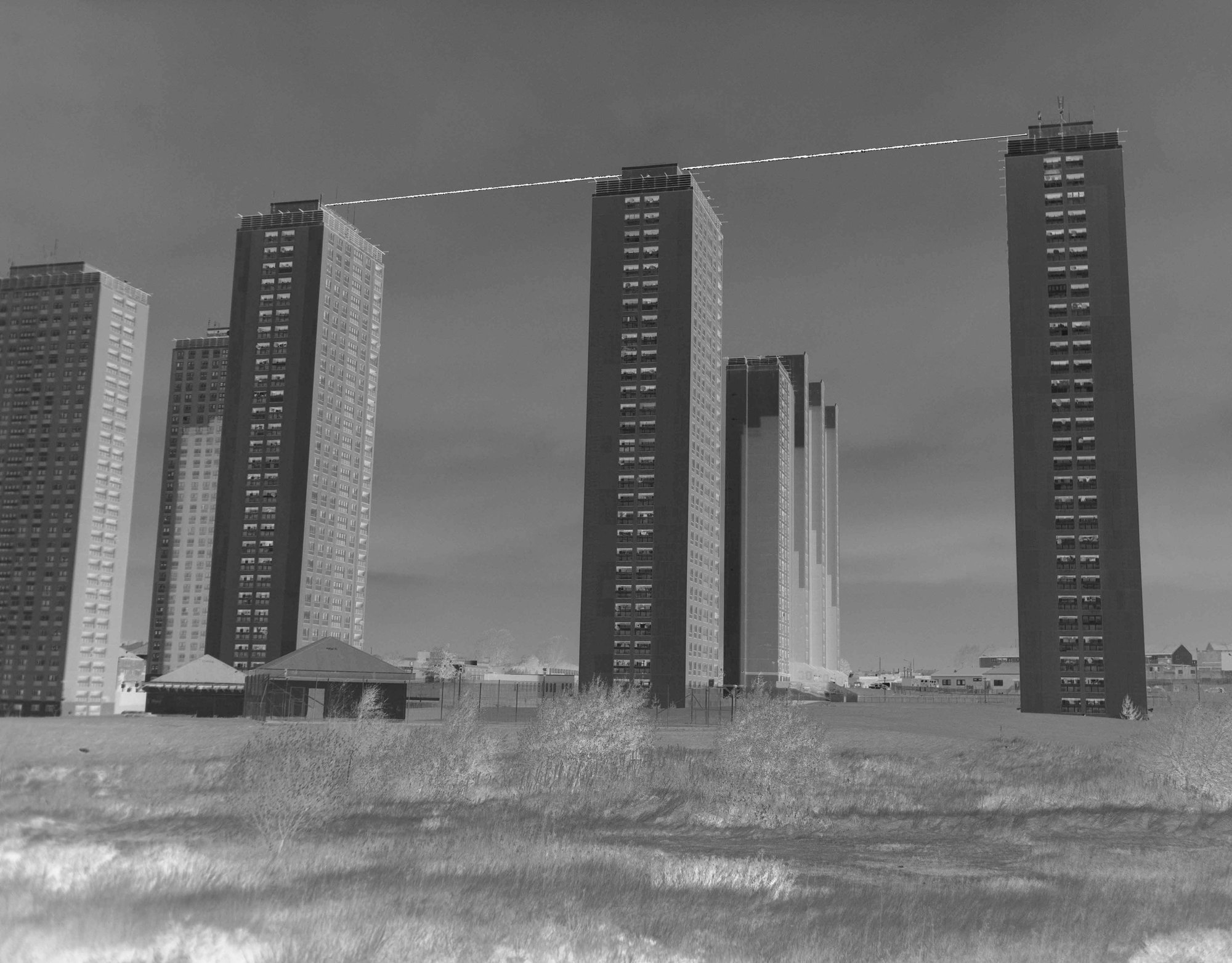
High Wire is a 4 channel installation that was filmed at the Red Road housing scheme in North Glasgow. The work presents a highwire artist attempting to walk a wire strung between two of the highrise blocks, 100 metres above the ground.
The 4 screens simultaneously show views of the highwire artist from afar, from his helmet camera and of the housing estate itself. High Wire is the ultimate expression of Yass’s enduring interest in the vertiginous view.
Register your interest
Fill out the form to find out more about how you can borrow and present this work, including tech specs, use cases, and more.
Making High Wire
By Catherine Yass
When I was a child I climbed out of my bedroom window, on to the roof and up to the top. It was about six in the morning. I sat astride the rooftop, exhilarated and frightened. Coming down was harder as the tiles kept slipping, making me lose my foothold.
High Wire is a dream of walking in the air, out into nothing. But it has an urban background and the high-rise buildings provide the frame and support. The dream of reaching the sky is also a modernist dream of cities in the air, inspired by a utopian belief in progress.
Every time I see Didier turning back I remember hearing him shout, from where I was standing on another rooftop, ‘C’est pas possible!’ But something was possible, he returned safely. And something emerged from the actuality of the walk, which was a moment when reality became more of a dream than the dream itself.
By James Lingwood, 2008
Before developing the idea of making a film of a man walking on a high wire, Catherine Yass had already made a number of photographic and video works which registered an experience of the urban environment from a startling perspective. In 2002, she suspended a film camera from a crane in London’s Docklands to create a destabilising video installation entitled Descent. Two years later, she attached a camera to a small remote-controlled helicopter which circled Broadcasting House, the BBC headquarters in London, to create another vertiginous viewing experience.
For both these works, Yass framed the idea, and then of necessity delegated the recording process. The proposal for High Wire involved a very different and more direct kind of human agency. By the time of our early meetings, the concept had crystallised as an idea to ask a high-wire artist to wear a tiny video camera attached to his head as he traversed the space between two very high buildings, walking on a very thin wire.
The choice of location was central to Yass’s conception for High Wire. She envisaged the high-wire artist walking between two concrete blocks of high-rise social housing: buildings emblematic of that momentous period in the history of the Western city when architects, planners and politicians first imagined, then began to implement, a vision for a new kind of city with a new kind of housing, reaching high into the sky.
Image: installation shot of High Wire at the Whitworth, The University of Manchester in 2011. Photograph: Michael Pollard
By Francis McKee, 2008
High Wire didn’t have to happen in Glasgow. As soon as the decision was taken to site it at the Red Road flats, however, the work took on a particular character unique to its location. The slab blocks built in the mid-sixties are an iconic part of the city’s history, representing both the best and the worst of urban planning.
Post-1945 Glasgow saw attempts by the city council to tackle its inner-city slums, recognised as the worst in Europe. A Glasgow Corporation Engineer, Robert Bruce, laid out a vision for the regeneration of the city in two documents, the First Planning Report and the Clyde Valley Regional Plan. The projected changes were radical, even by the standards of post-war planners. A surviving film of an architectural model of the new city centre shows that almost all the Victorian buildings would have been demolished, including sites such as Rennie Mackintosh’s School of Art, the Kelvingrove Museum, the City Chambers and Central Station. In their place rose skyscrapers serviced by a series of motorways and a monorail. The Bruce Plan, as it became known, also laid out blueprints for the large-scale construction of high-rise housing in the style of Le Corbusier. This was a classic welfare state appropriation of modernist principles, in line with developments across Britain and other parts of Europe. The scale of the Bruce Plan, though, was unprecedented as it sought to deal with the city’s pervasive slums.
Much of this futuristic vision was never implemented. Glasgow city centre, although ringed with motorways, remains intact as the plans lost momentum and were eventually replaced by a new policy of regeneration that focused on the cleaning and preservation of heritage buildings.
About Didier Pasquette
The high-wire walker strives to lure the audience away from thoughts of death by the beauty of what he does on the wire. His job is to create a sensation of limitless freedom.
Didier Pasquette is one of the few great high wire artists working at the present time. Born in France where he studied with Philippe Petit (famous for his 1974 high wire walk between the twin towers of New York’s World Trade Center), Pasquette performs in circus shows, and undertakes special high wire walks in dramatic environments.
In 1997, Pasquette walked with a colleague on a 430 metre wire 30 metres above the River Thames. To celebrate the millennium, he walked along a specially rigged high wire running along the Greenwich Meridian in Northern France. In 2005 he walked the length of the pitch on a wire stretched high above the Stade de France in Paris.
The high wire walk at Red Road in North Glasgow marked a new change of scene for Pasquette, exchanging the beautiful surroundings of tourist landmarks for the gritty realities of a post-war housing estate, its tower blocks conceived as streets in the sky.
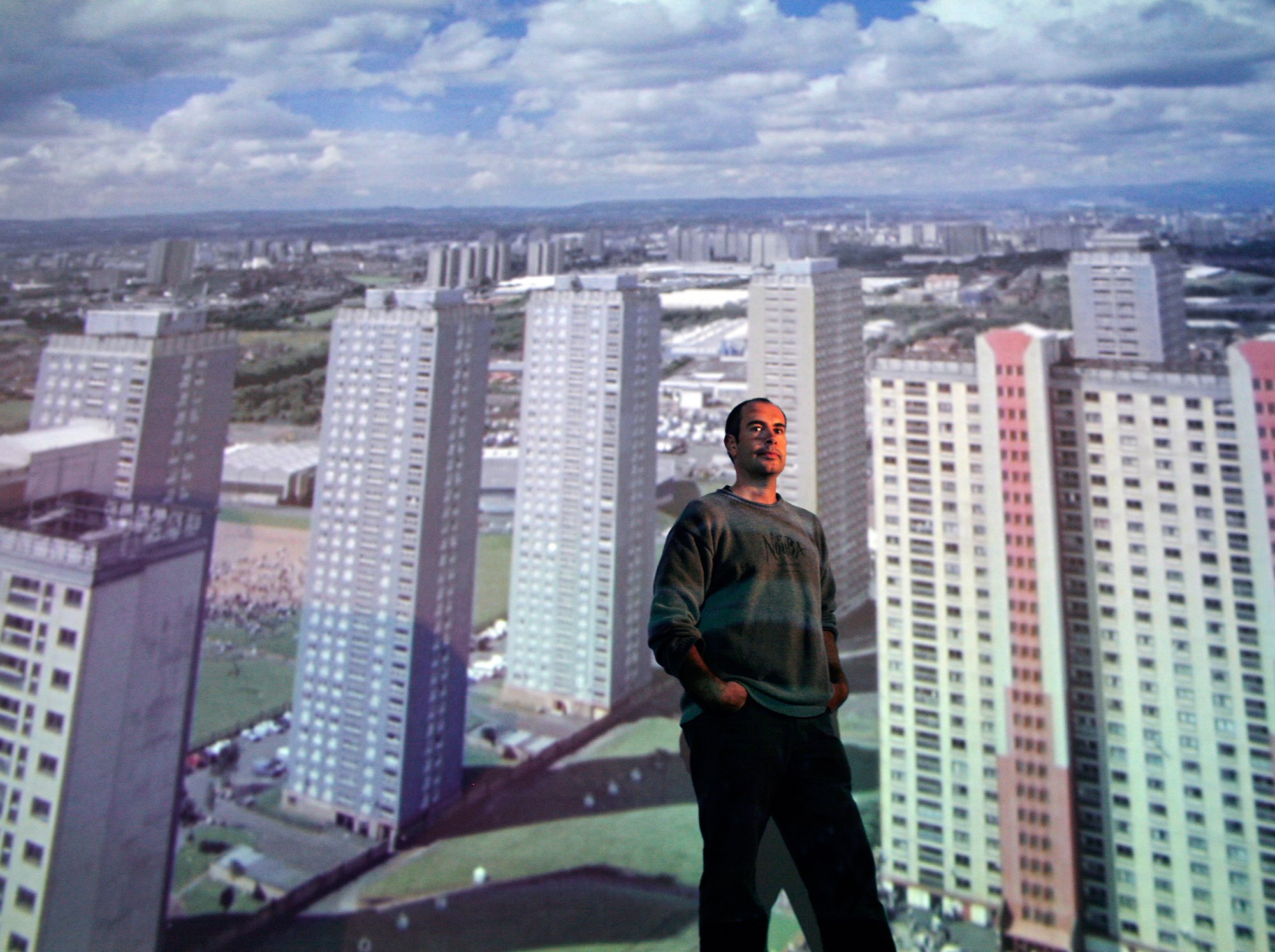
Image: Didier Pasquette in front of the project High Wire film at Centre for Contemporary Arts, Glasgow (2008). Photograph: Angie Catlin
About Red Road
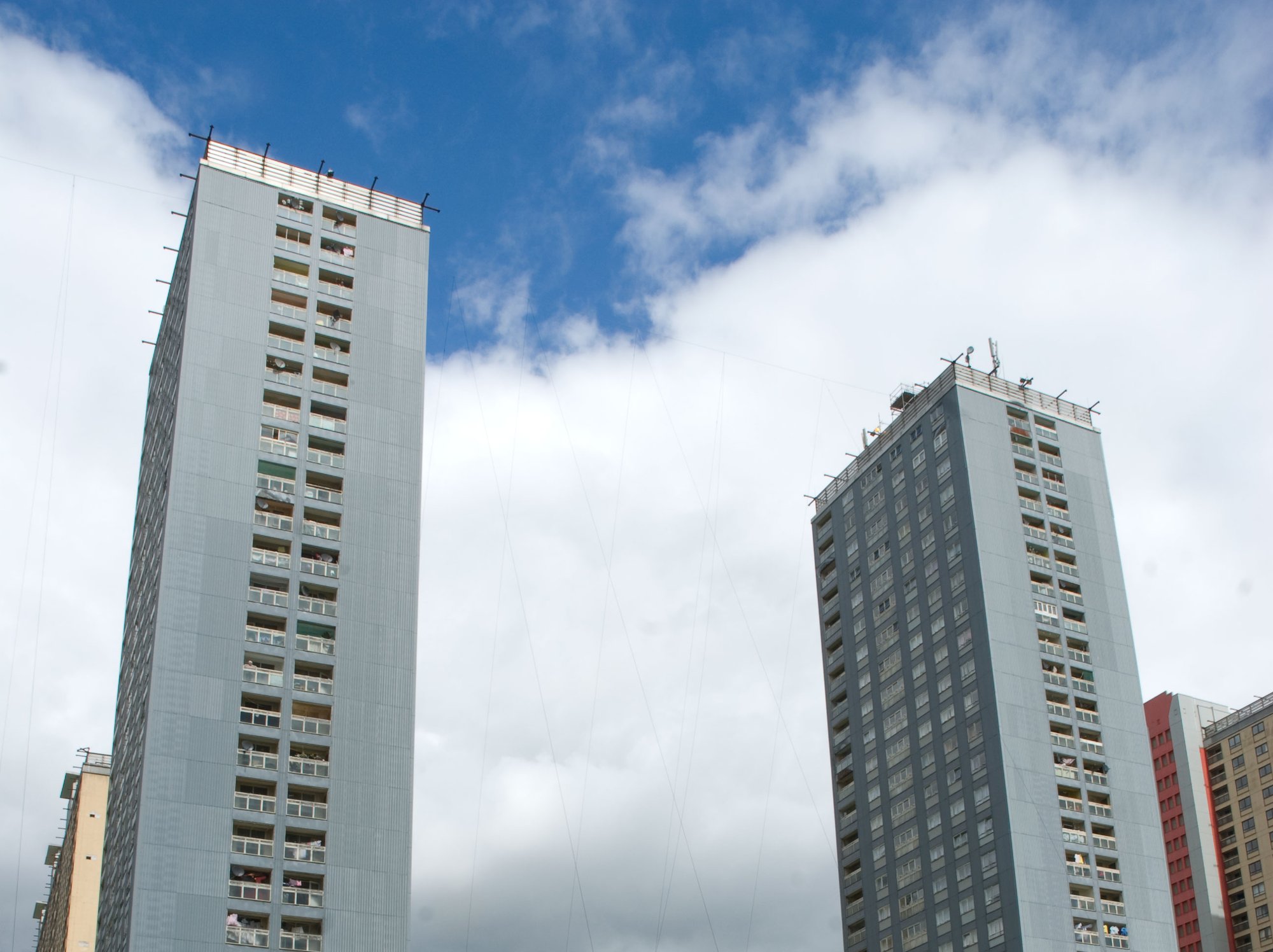
In the 1960s Glasgow faced serious economic decline, with cheaper labour abroad threatening industry and war damage to housing still much in evidence. To arrest this deterioration, politicians implemented a scheme to replace the worst slums with a new generation of high-rise and large suburban housing estates, locally known as schemes. Tall blocks were erected as part of mixed developments that combined both low- and high-rises, of which one of the most radical was the bold, steel-framed towers of Red Road, designed by architect Sam Bunton Junior.
The Red Road development of 1962-9 was the highest in Europe, consisting of eight high-rise blocks, the tallest reaching 31 storeys. Working alongside efforts to alleviate problems of overcrowding in inner city communities, Red Road was designed to house 4,700 people. However, the ambitious scale of the development soon attracted management problems and Red Road gained a reputation for anti-social activity and crime.
Improved security has led to a dramatic drop in crime and many of the flats have now been privatised. In 2005 Glasgow Housing Association announced a £60 million regeneration plan for Red Road. The eight tower blocks are set for demolition over the next decade, to be replaced by around 600 low-rise private and social-rented homes.
Image: production shot from the filming of High Wire in 2007, by Catherine Yass, photographer: unknown.
Catherine Yass
Catherine Yass is one of the most innovative artists working with film and photography today. She was nominated for the Turner Prize in 2002 and has recently exhibited her work in the USA, Spain, the Netherlands and Japan.
Her short films generate startling new perspectives on the urban environment, capturing familiar sights from highly unusual vantage points. Presented upside down,Descent (2002) was filmed from a massive construction site at London’s Canary Wharf, the camera lowered from a crane through the morning mist. Flight (2002) was made from a remote-controlled helicopter circling the BBC Television Centre in London. In her recent film Lock (2006), Yass filmed the Three Gorges Dam on China's Yangtze River.
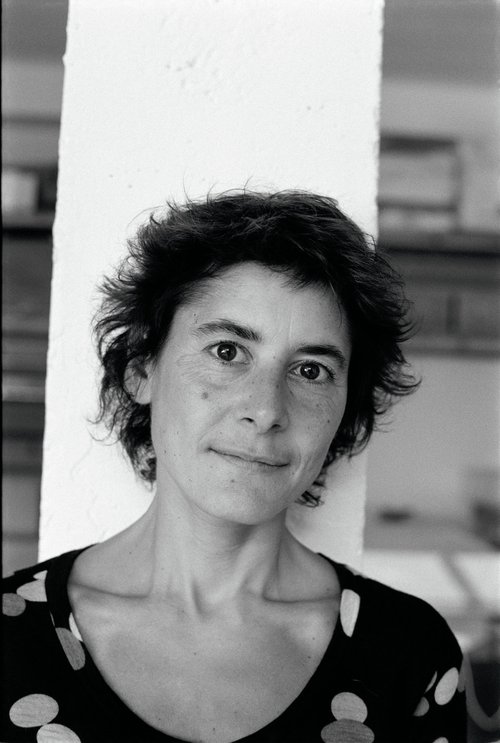
Images: (left) Catherine Yass, High Wire (from Red Road Recreation ground) (2008) Ilfotrans transparency, lightbox; (above) portrait of Catherine Yass
How does his defiant urge connect with the utopian dreams that impelled architects, planners and politicians to create such dwellings in the sky? — Richard Cork, The Independent
Pasquette is seen transcending the grey landscape and revelling in the isolation above. It is a beautiful parable of man’s attempted flight from reality. — Jessica Lack, The Guardian Guide, 13 October 2008.
Your eyes dart from one projection to the next, struggling to compare close and distant views of Pasquette with images of his helmet camera. All this visual information, so much more complex than that of gazing up at a circus act, makes you identify with this lonely figure. Pitched against the void, he seems so vulnerable. What drives him to attempt such a wild and unlikely feat? How does his defiant urge connect with the utopian dreams that impelled architects, planners and politicians to create such dwellings in the sky? — Richard Cork, The Independent, 21 September 2008.
Yass’s work often presents the ordinary and objective architectural world as something charged with psychological tension and anxiety; with High Wire, that intensity is a product of Pasquette’s failure to ‘perform’, and the peculiar stress that one experiences as one witnesses his personal difficulty close-up, contrasted with the blank indifference of the landscape of tower blocks seen at a distance. — JJ Charlesworth, Time Out London, 16 – 22 October 2008
Comprising of a four-screen film installation, and back-lit images, High Wire intertwines the artist’s fantasies of a gravity-defying amble, with welfare-state social ideals to address Britain’s acute 1960s housing problems. – Pauline Bache, Aesthetica Magazine
Credits
It was co-commissioned by Glasgow International Festival of Contemporary Visual Art. The work was supported by the National Lottery through the Scottish Arts Council, Republique Francaise/ Institut Francais, The Henry Moore Foundation, Alison Jacques Gallery, London and Lelong Gallery, New York. High Wire is included in The Artangel Collection, a national initiative to commission and present new film and video work, supported by the National Lottery through Arts Council England and the Esmée Fairbairn Foundation.
Artangel is generously supported by Arts Council England, and by the private patronage of The Artangel International Circle, Special Angels, Guardian Angels and The Company of Angels.