
I see this as the ultimate consumer choice. Once Break Down has finished, a more personal 'break down' will commence, life without my self-defining belongings… One way or other I'm trying to get rid of myself, so it's kind of the ultimate way without actually dispensing of me. - Michael Landy
Michael Landy on Break Down
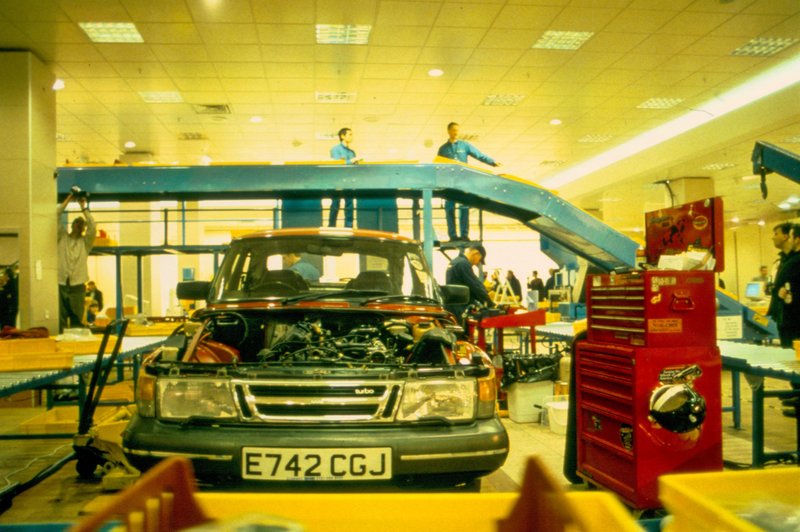
"Mike, is there life on Mars?" This is what Dave Nutt, my Buddhist Saab mechanic would shout up at me standing on the platform, as he was ripping through my Saab 900 165 turbo 16S, as we listened to the umpteenth David Bowie record on my B&W speakers.
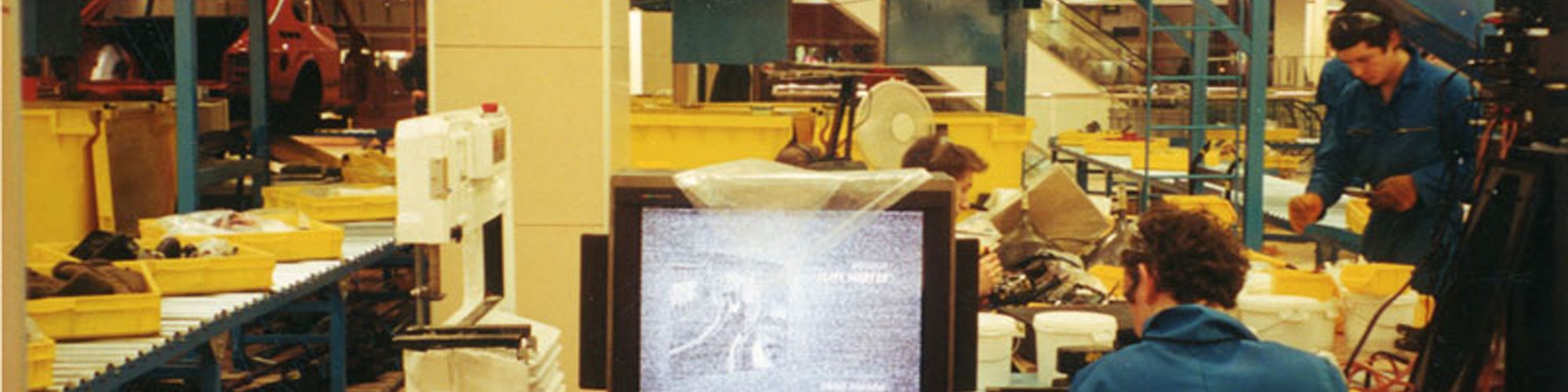
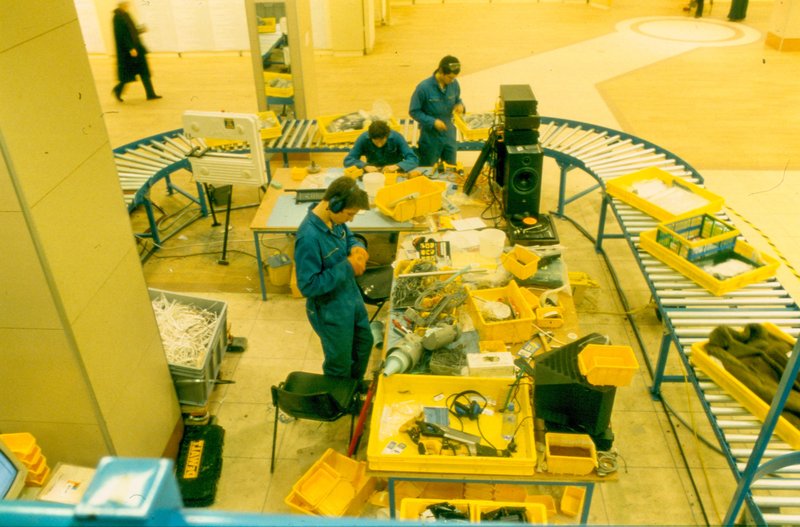
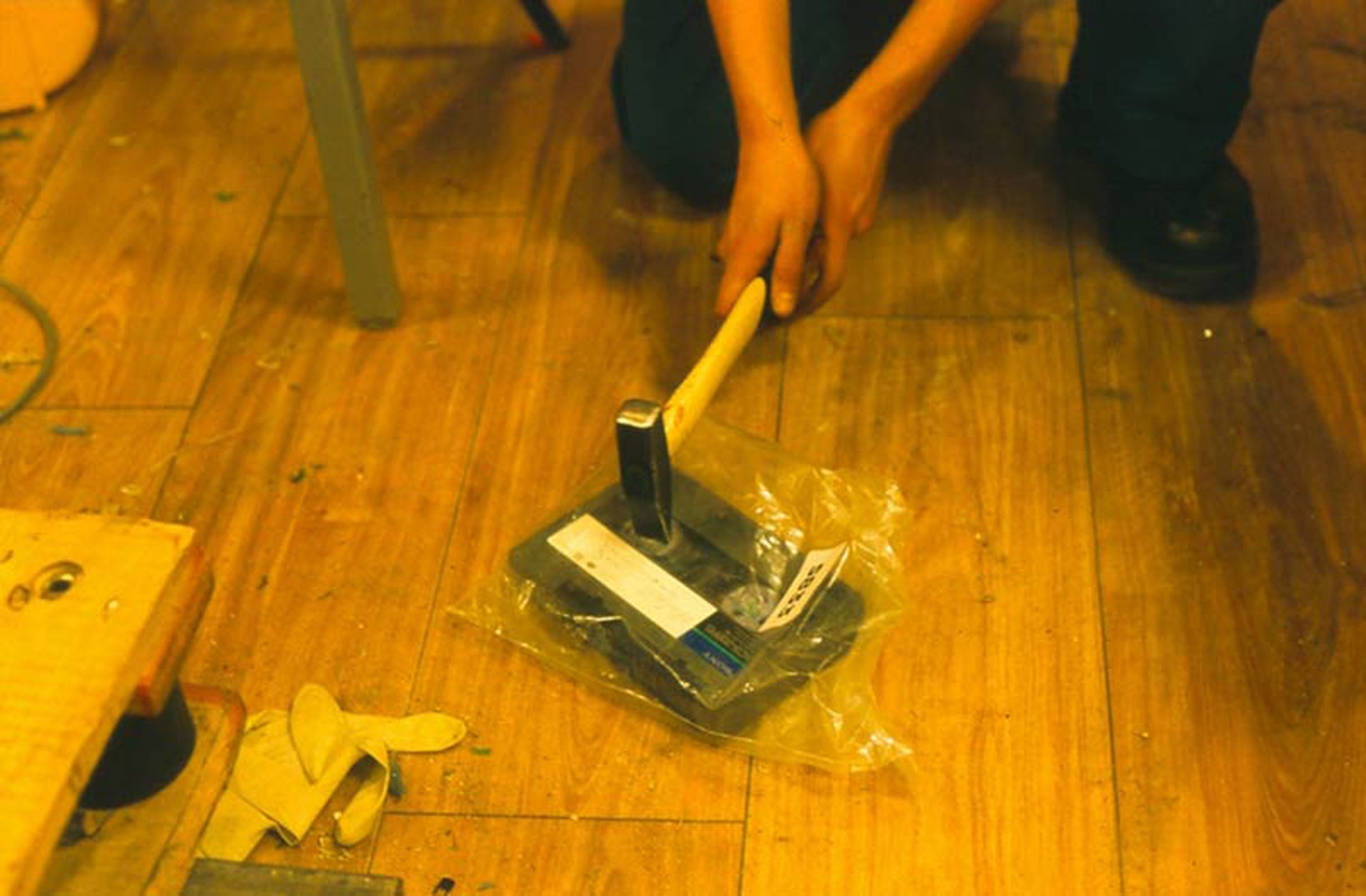
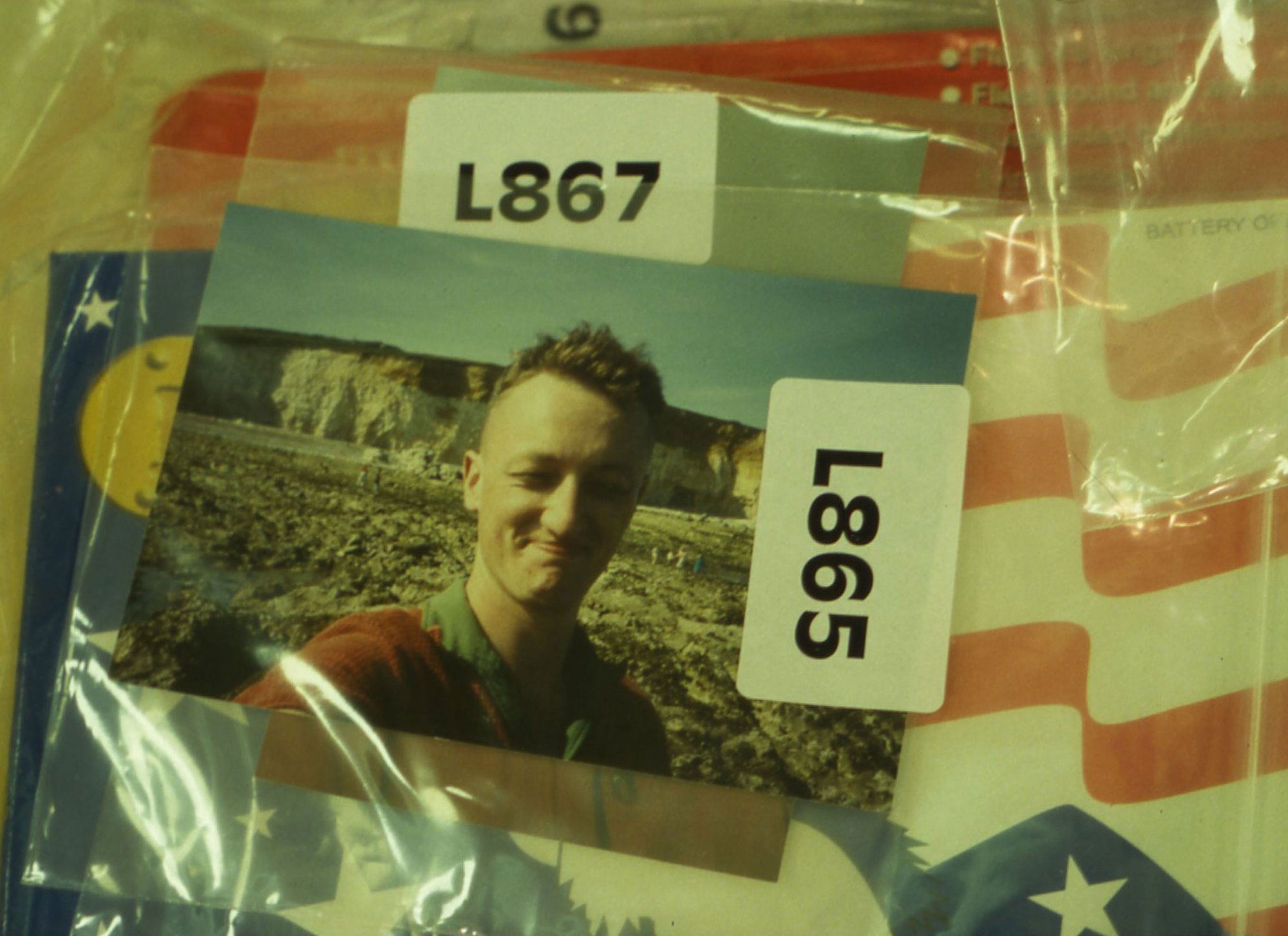
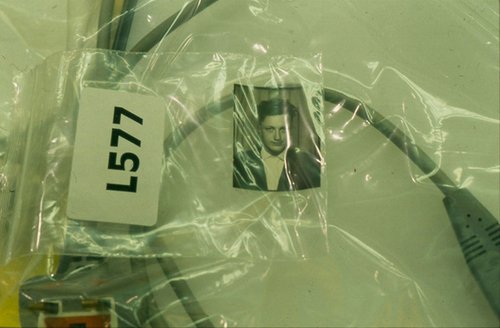
For two weeks, and two weeks only, we had set ourselves the task to destroy my worldly possessions, all 7,227 of them. I hadn't really considered whether we could do it or not, since to the best of my knowledge, no-one had attempted this feat before.
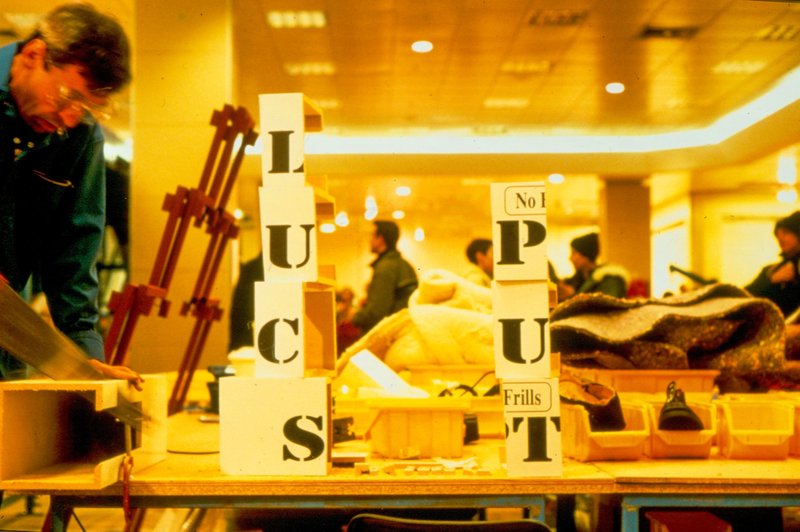
Within no time at all, dismantling my belongings or watching them travelling around in the yellow trays on the 100 metre conveyor belt in front of would be shoppers became normal.
This is what I did along with 12 of my operatives – whom I now call 'disciples'.
Playlist: Imagine No Possessions
Playlist: Imagine No Possessions
A selection of the records, CDs and cassette tapes destroyed by Michael Landy and his team. Spotify users can listen to most of the tracks from this playlist here.
The Specials: Man at C&A
David Bowie: Breaking Glass
Echo and the Bunnymen: The Cutter
Queen and David Bowie: Under Pressure
Stranglers: Strange Little Girl
Diana Ross: Upside Down
Marc Bolan: You Scare Me to Death
Tom Tom Club: Tom Tom Club
John Martyn: Solid Air
Iggy Pop: Lust for Life
John Lennon: Imagine
Talking Heads: Little Creatures
The Associates: Sulk
Bauhaus: Ziggy Stardust
Heaven 17: Fascist Groove Thang
Grace Jones: Warm Leatherette
Cocteau Twins: Peppermint Pig
Joy Division: Love Will Tear Us Apart
Birthday Party: Nick the Stripper
The Police: Message in a Bottle
The Damned: I Just Can't Be Happy Today
The Crusaders: Street Life
The Jam: Beat Surrender
Chaka Khan: I Feel For You
Secret Affair: Time For Action
UK Subs: Tomorrow's Girls
Eurythmics: Who's That Girl
Madonna: Lucky Star
Rolling Stones: Start Me Up
Joyce Sims: All and All
Candi Statton: Young Hearts
Bill Lovelady: Reggae For it Now
Culture Club: Time (Clock of the Heart)
Phil Collins: In the Air Tonight
Dalis Car: The Judgement is the Mirror
Kiki Dee and Elton John: Don't Go Breaking My Heart
OMD: Swing Shift
The Flying Lizards: Money
Style Council: Money Go Round
Funeral Directors: Corpsegrinder
Fun Boy Three: Summertime
Gymslips: 48 Crash
Softcell: Bedsitter
Total Contrast: What You Gonna Do About It
Adam & the Ants: Deutsche Girls
The Creatures: Drive in Saturday
Hi Fi: Don't Break the Spell
Frankie Goes to Hollywood: Relax
Siouxsie and the Banshees: Melt!
Japan: Quiet Life
Blur: The Debt Collector
Jim Reeves: Old Tige
The Verve: Lucky Man
Paul Weller: You Do Something to Me
Radiohead: Nice Dream
Orbital: Halcyon and On and On (Live)
Happy Mondays: Lovechild
Nirvana: In Bloom
Garbage: I Think I'm Paranoid
Squeeze: Cool for Cats
The Cure: A Forest
B52s: Rock Lobster
Cameo: Single Life
The Clash: London Calling
Lou Reed: Satellite of Love
The Human League: Being Boiled
Level 42: Something About You
Gary Numan: Cars
Manic Street Preachers: The Everlasting
Fleetwood Mac: Go Your Own Way
The Outcasts: Angel Face
Air: All I Need
Michael Nyman: Drowning by Numbers
The Wolfe Tones: Let the People Sing
Bronski Beat: Smalltown Boy
The Hues Corporation: Rock the Boat

The Inventory
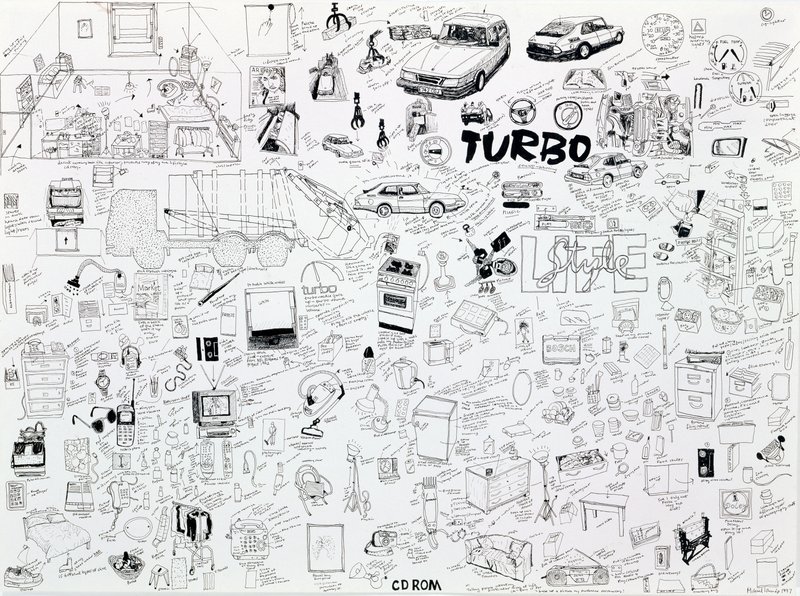
Before Michael Landy destroyed his possessions, he spent a year making a list of them. The full inventory contained 7,227 entries, split into the following ten categories:
A - Artworks
C - Clothing
E - Electrical
F - Furniture
K - Kitchen
L - Leisure
P - Perishables
R - Reading
S - Studio
V - Vehicle
Michael Landy in Conversation With Dave Nutt
In early 2010, nine years after Break Down, Michael Landy installed a 600 cubic metre see-through bin — Art Bin — into the South London Gallery, into which he asked artists to throw their creative failures. "There's no hierarchy in the bin, all artists are the same," he said, "and I've left it up to them to interpret what failure means".
Dave Nutt was the mechanic who dismantled Landy's cherry red Saab in 2001. The car was the sole entry in the 'vehicle' category of Landy's Break Down inventory. As the bin slowly filled, we asked Nutt to talk to his former client...
Dave Nutt: Michael.
Michael Landy: Dave Nutt.
D: How are you?
M: I'm fine. What a great name that is - Dave Nutt.
D: Is that why you gave me the Break Down job do you think?
M: No, it's more that you talked to us about the ethos of Saab for about two hours outside my council flat near Tower Bridge. That's what really attracted me to you.
D: But it helped a little bit that I was called Dave Nutt?
Michael Landy
Michael Landy's first experience working with Artangel was on the construction of Rachel Whiteread's House in 1993. He was then selected as part of the 1999 Open call for proposals and created Break Down in 2001.
Known as one of the most thought provoking artists of the ‘Sensation Generation’, Landy’s work was first shown in the legendary Freeze exhibition of 1988. Through the 1990s, Landy’s work explored contemporary consumerism in a sequence of major projects stretching from Market and Closing Down Sale early in that decade, to the sprawling shredded landscape of Scrapheap Services.
In the year following Break Down, Landy worked on a series of painstakingly detailed etchings of weeds, rendered in the traditional style of botanical draughtsmanship. In 2004, he created Semi-detached, a full scale model of the front and back facades of his parents’ house, shown at Tate Britain. In more recent times he has created drawings in charcoal, oilstick, glue and ink that reference Homage to New York, Jean Tinguely’s self-destructing machine which, for 27 minutes in 1960, spasmed, shook, and burst into flames but failed to fully self-destruct.
Michael Landy in Conversation with Julian Stallabrass
This interview originally appeared in Michael Landy / Break Down, a publication – part manual, part inventory and part research file – created to accompany the project in 2001.
JS: Will it be only consumer objects that you destroy, or will there be more personal items, like letters, photographs...
ML: I started out thinking about consumer objects but in the end found it very hard to draw the line between those items and my other possessions, so I decided to destroy everything, including art works, photographs, all kinds of things that I didn't exactly buy.
Michael Landy: Break Down
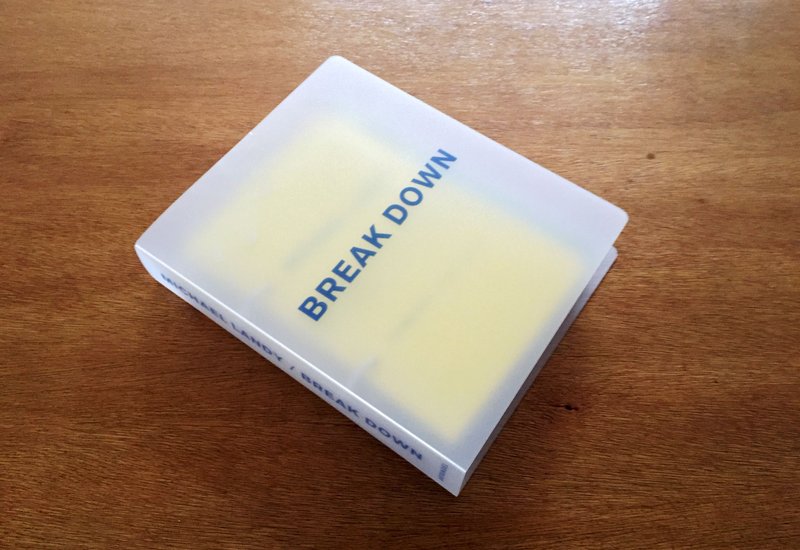
This artist's book – part manual, part inventory, part research file – includes the complete list of his possessions, drawings, photographs, a collage of research materials and an interview with Julian Stallabrass, as well as a section of photographs from the actual installation in Oxford Street in London, February 2001.
- Unpaginated 128pp
- Hardcover
- Loose pages bound in a two-ring translucent binder with title printed on cover and spine
- Includes numerous four-color and black-and-white illustrations
- 238 x 196 x 40mm
- ISBN: 1902201108
Michael Landy: Break Down – Inventory
This book represents the complete record of all Michael Landy’s possessions – all 7088 items. Classified into ten different categories – Artworks, Clothing, Equipment, Furniture, Kitchen, Leisure, Motor Vehicle, Perishables, Reading Material and Studio Material – this volume presents an extraordinary and, at times, intensely biographical inventory list of all items destroyed.
- Published by Ridinghouse, 1 May 2002
- The inventory was drawn up by Michael Landy with the assistance of Clive Lissaman
- 300pp
- Softback
- Black-and-white illustrations
- 230 x 171mm
- ISBN: 9780954171018
The ultimate irony of Break Down is that, as soon as it ends, Landy will have turned himself into the ideal consumer – a man who needs to be sold new underwear, pyjamas, shoes, toothbrush, hairbrush. – Richard Dorment, The Daily Telegraph
Artists have been known to destroy their own work and even to kill themselves, but usually it is in a fit of despair or rage. Landy's art is quintessentially modern because it is so ruthlessly efficient, so mechanised. This work took him two years to organise. At first glance the scene inside C&A looks like a factory hard at work making things. Only up close do you see that a process of destruction is taking place which is as complex as the process of creation. – Richard Dorment, The Daily Telegraph, 14 February 2001.
Break Down, Landy's strongest work to date, embodied more than a social commentary on shopping. His gesture of publicly stripping himself of his worldly goods had a spiritual dimension. He behaved as a shaman might, enacting a purge for communal ends. – Judith E. Stein, Art in America, June 2001.
Break Down was a real event, the first Brit Art gesture I have seen that transcended the new-establishment, new-elite, bad-boy banalities of Landy's contemporaries. He's a thinker, and a tough-minded one at that. Is it art? I don't know, but for once, thanks to the carefully reasoned rigour and impersonality of the project, I think so. – Bryan Appleyard, The Sunday Times, 11 March 2001.
Credits
Break Down was commissioned from The Times / Artangel Open, with the support of the National Lottery through the A4E scheme administered by the Arts Council of England, Thomas Dane, Karsten Schubert, Anita and Poju Zabludowicz.
Artangel is generously supported by the private patronage of The Artangel International Circle, Special Angels, Guardian Angels and The Company of Angels.